| Statistics: |
Original Author: Marcia & Robert Ascher
Museum: Museum für Völkerkunde, Berlin, Germany
Museum Number: VA42528
Provenance: Pachacamac
Region: Unknown
|
# of Cords: 28 (16p, 12s)
# of Unique Cord Colors: 8
Benford Match: 0.6073
# Ascher Sums (pps, ips, cps, sps,...): 2 (2, 0, 0, 0,...)
Similar Khipu: Previous (AS072) Next (AS155)
|
|
| Notes: |
Ascher Databook Notes:
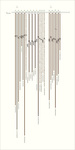
- Only clusters of single knots are used on both parts of the khipu. The lower knot cluster position has been interpreted as the units position and the higher as the tens position.
- Construction note: AS101 - Part 2 consists of 2 khipus. The twisted ends of the main cords of the 2 parts are tied together with a square knot.
- This is one of several khipus acquired by the Museum in 1907 with provenance Pachacamac. For a list of them, see UR1097.
- Parts I and II are related by color and value patterning.
- By color and spacing, Part I is 3 groups of 3 pendants each while Part II is 4 groups of 4 pendants each. The relationship of the colors of the pendants and subsidiaries for both parts is shown in Table 1.
- In Part I, in every group, for pendants and subsidiaries, the value of position 1 equals the value of position 3. Thus, each group has an ABA pattern. In Part II, in every group, for pendants and subsidiaries, the value of position 1 equals the value of position 2 equals the value of position 4. Thus, each group has an AABA pattern. The values of the pendants and subsidiaries for both parts is shown in Table 2.
TABLE 1
| Part I | | Part II | |
| Pendants in group 1 | LB or W | Pendants in group 1 | LB |
| Subsidiaries in group 1 | G0 | Subsidiaries in group 1 | G0, GY, or LB:W |
| Pendants in group 2 | W | Pendants in group 2 | W |
| Subsidiaries in group 2:s1l | KB | Subsidiaries in group 2 | KB |
| Subsidiaries in group 2:s2 | LB:W | Pendants in group 3 | LB:W |
| Pendants in group 3 | DB or DB:LB | Pendants in group 4 | DB or DB:LB |
| Subsidiaries in group 3 | DB:LB | Subsidiaries in group 4 | DB:LB |
TABLE 2
| Part I | | Part II | |
| Pendants in group 1 | 16,18,16 | Pendants in group 1 | 3,3,7,3 |
| Subsidiaries in group 1 | 8,14,8 | Subsidiaries in group 1 | 2,2,5,2 |
| Pendants in group 2 | 3,4,3 | Pendants in group 2 | 7,7,9,7 |
| Subsidiaries in group 2:sl | 3,4,3 | Subsidiaries in group 2 | 3,3, 4, 3 |
| Subsidiaries in group 2:s2 | 16,18,16 | Pendants in group 3 | 3,3,7,3 |
| Pendants in group 3 | 3,4,3 | Pendants in group 4 | 6,6,12,6 |
| Subsidiaries in group 3 | 16,18,16 | Subsidiaries in group 4 | 4,4,6,4 |
|
| Bibliography: |
Bibliography for AS101 - Part 2/KH0115:
| Year |
Author |
Title |
Pages |
| 1978 |
Ascher, Marcia, and Robert Ascher. |
Code of the Quipu: Databook. University Microfilms, Ann Arbor. |
680; 700; 701-704 |
| 1981 |
Ascher, Marcia, and Robert Ascher. |
Code of the Quipu: A Study in Media, Mathematics, and Culture. University of Michigan Press, Ann Arbor. |
122; 123-124 (ex.6.8) |
| 2002 |
Ascher, Marcia. |
Labels, Structure, and Format. In Narrative Threads: Accounting and Recounting in Andean Khipu, edited by Jeffrey Quilter and Gary Urton, pp. 87-102. University of Texas Press, Austin. |
100-101; 102 |
| 2010 |
Chirinos Rivera, Andrés. |
Quipus del Tahuantinsuyo: Curacas, Incas y su saber matemático en el siglo XVI. Editorial Commentarios, Lima. |
235; 238; 257-262; 268; 340 |
| 2024 |
Hyland, Sabine. |
Knot Anomalies on Inka Khipus: Revising Locke’s Knot Typology. In IX International Conference on Pre-Columbian and Amerindian Textiles / 9th International Conference on Pre-Columbian and Amerindian Textiles, Museo delle Culture, Milan, 2022, pp. 162-180. Zea Books, Lincoln, Nebraska. |
172 |
| 2010 |
Urton, Gary. |
Recording measure(ment)s in the Inka khipu. In The archaeology of measurement: comprehending heaven, earth and time in ancient societies, edited by Iain Morley and Colin Renfrew, pp. 54-68. Cambridge University Press, Cambridge. |
59 |
| 2014 |
Urton, Gary. |
Quipus de Pachamac. Ministerio de Cultura, Lima. |
43 |
| 2017 |
Urton, Gary. |
Inka History in Knots: Reading Khipus as Primary Sources. University of Texas Press, Austin. |
123; 261 |
|