| Section |
Information |
| Statistics: |
Original Author: Marcia & Robert Ascher
Museum: Museum für Völkerkunde, Berlin, Germany
Museum Number: VA63042(B)
Provenance: Nazca
Region: Unknown
|
# of Cords: 289 (269p, 20s)
# of Unique Cord Colors: 16
Benford Match: 0.3732
# Ascher Sums (pps, ips, cps, sps,...): 50 (37, 4, 8, 0,...)
Similar Khipu: Previous (AS050) Next (AS013)
|
|
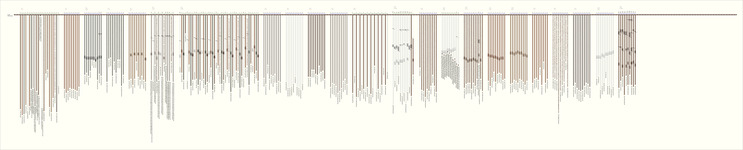
| AS128/KH0143 |
 |
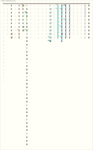
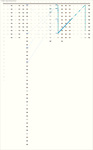
| Pendant Pendant Sum |

 |
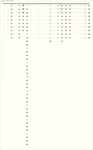
| Indexed Pendant Sum |

 |
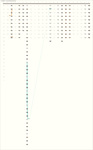
| Colored Pendant Sum |
 |
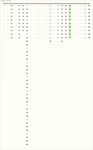
| Group Sum Bands |
 |
| DataFile: |
AS128
|
| Notes: |
Ascher Databook Notes:
- Pendants 7-13 are irregularly attached to the main cord. They have the appearance of being retied onto it.
- Pendants 62-69 have been repaired where they are attached to the main cord. Two detached pendants stored with the khipu may be associated with this group of pendants. One of the fragments is KB-W with value 12, and the other is KB-W with value 40 and with a DB:W subsidiary with value 10.
- The pendants in this group are KB joined to W. However, all are broken just where the colors are joined.
- Pendant 199 is the same color as the pendants with which it is grouped but it differs from them in texture. It also differs from them in order of magnitude.
- AS127, AS128, and UR1176 were acquired by the Museum in 1933 with provenance Nazca. AS127 and AS128 are loosely tied together.
- By spacing, the khipu is separated into 6 parts.
- The first part is 1 group of 22 pendants all of value 0 (or blank).
- Part 2 is 5 groups of 8-10 pendants each. Each group is unified by having all pendants the same color. The first group has all values of 0; the values of the 4th group alternate 1, 0, 1, 0, etc. The last group in this part has only 8 pendants but may have had 10 (see #2 above).
- The 40 pendants in part 3 repeat the color pattern W, BS, 0D, DB:KB 10 times. The only subsidiaries are on the BS colored pendant and all are DB:W. For each of the 10 sets of 4 pendants, the values have the same relative magnitude: W > BS > 0D ≥ DB:KB.
- Part 4 is 5 groups of 10 pendants each. Each group is unified by having all pendants the same color. All pendant values are 0 (or blank).
- Part 5 is 10 groups of 9-11 pendants each. With the exception of the 11th pendant in the first group, each group is unified by having all pendants the same color.
- In the 2 groups that have 11 pendants, one of the pendants is exceptional by color or texture. The values of these exceptional pendants (Pl70 and Pl9 9) are related in the same way to the sum of the values of the pendants that follow them. The value of pendant 17 0 and its subsidiary equals 5 more than the sum of pendants 17 7-198. Then pendant 199 equals 5 more than the sum of pendants 200-221. [These pendants together span groups 2-6 of part 5. Since all the pendants in groups 7-9 are zero-valued, the sums could be extended to include them. ]
- Pendants 1-3 of groups 3-5 have the same relationships to each other as do pendants 5-7 of these same groups. In each case, the 9 pendants form the pattern:
| Group | Pi | Pi+1 | Pi+2 |
|---|
| Group 3 | a+1 | a+1 | a+1 |
| Group 4 | a | a | a |
| Group 4 | a | a | a |
Where a=3 when Pi=P1 and a=4 when Pi=P5
- Part 6 is 1 group of 10 pendants all of color DB.
- Finally, returning to part 1, the pendant color order is related to the color order of the other groups on the khipu. (In #1 above, it is noted that some of the pendants in this group appear to be retied. Some pendants could, therefore, be missing or rearranged.)
- P2-4 are in the color order of groups 1-4 of part 2 with 1 omission.
- P5-7 are in the color order of the first 3 colors of the 4 color pattern of part 3.
- P8-12, with one exception, are the colors of the groups in part 4 but not in order.
- P13-22, with one exception, are in the color order of groups 1-10 of part 5.
- P1 is the color of the group in part 6.
|
| Bibliography: |
Bibliography for AS128/KH0143:
| Year |
Author |
Title |
Pages |
| 1978 |
Ascher, Marcia, and Robert Ascher. |
Code of the Quipu: Databook. University Microfilms, Ann Arbor. |
829; 830-845 |
| 2005 |
Ascher, Marcia. |
How Can Spin, Ply, and Knot Direction Contribute to Understanding the Quipu Code? Latin American Antiquity 16(1):99–111. |
102 |
| 1925 |
Kreichgauer, P. Dam. |
Bibliograpie: Nordenskiöld: The Secret of the Quipu. Anthropos 20:1193-1194. |
1194 |
| 1926 |
Kreichgauer, P. Dam. |
Das Rätsel der Quipus. Anthropos 21:618-620. |
618; 619 |
| 1970 |
Mackey, Carol. |
Knot Records in Ancient and Modern Peru. PhD dissertation, Anthropology, University of California, Berkeley. |
211 |
| 2021 |
Medrano, Manuel. |
Quipus: Mil años de historia anudada en los Andes y su futuro digital. Planeta, Lima. |
- |
| 1925 |
Nordenskiöld, Erland. |
The Secret of the Peruvian Quipus. Elanders, Gothenburg. |
27-29; 34 |
| 1949 |
Radicati di Primeglio, Carlos. |
Introducción al estudio de los quipus. Documenta, Revista de la Sociedad Peruana de Historia 2(1):244-339. |
256; 275 |
| 1976 |
Radicati di Primeglio, Carlos. |
El sistema contable de los Incas: Yupana y Quipu. In Estudios sobre los quipus, edited by Gary Urton, pp. 265-354. Universidad Nacional Mayor de San Marcos, Lima. |
321; 350 |
| 1984 |
Radicati di Primeglio, Carlos. |
El secreto de la quilca. In Estudios sobre los quipus, edited by Gary Urton, pp. 355-408. Universidad Nacional Mayor de San Marcos, Lima. |
362 |
| 1987 |
Radicati di Primeglio, Carlos. |
Hacia una tipificación de los quipus. In Quipu y Yupana: Colección de Escritos, edited by Carol Mackey, Hugo Pereyra, Carlos Radicati, Humerto Rodriguez, Oscar Valverde, pp. 89-95. Consejo Nacional de Ciencia y Tecnología, Lima. |
93 |
| 1990 |
Radicati di Primeglio, Carlos. |
El cromatismo de los quipus: Significado del quipu de canutos. In Quipu y Yupana: Colección de Escritos, edited by Carol Mackey, Hugo Pereyra, Carlos Radicati, Humerto Rodriguez, Oscar Valverde, pp. 39-50. Consejo Nacional de Ciencia y Tecnología, Lima. |
40 |
| 1994 |
Urton, Gary. |
New Twist in an Old Yarn: Variation in Knot Directionality in the Inka Khipus. Baessler-Archiv Neue Folge 42:271-305. |
299 |
| 2017 |
Urton, Gary. |
Inka History in Knots: Reading Khipus as Primary Sources. University of Texas Press, Austin. |
261 |
|