| Section |
Information |
| Statistics: |
Original Author: Marcia & Robert Ascher
Museum: American Museum of Natural History, New York, NY, USA
Museum Number: 41.2/6702
Provenance: Ica
Region: Unknown
|
# of Cords: 7 (2p, 5s)
# of Unique Cord Colors: 5
Benford Match: 0.4544
# Ascher Sums (pps, ips, cps, sps,...): 0 (0, 0, 0, 0,...)
Similar Khipu: Previous (UR103) Next (AS195)
|
|
| AS194/KH0212 |
 |
| DataFile: |
AS194
|
| Notes: |
Ascher Databook Notes:
- AS190-AS197 were all purchased by the Museum in 1969 from Louis Slavitz, their provenance is near Callengo, Ica Valley. They are compared following AS191.
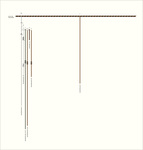
- Construction note: AS194 and AS195 are remarkably similar. Since the second pendant cord on AS194 is separated from the first by 21 cm., is blank, and is only 1 cm. from the knotted end, it is assumed that it is an ending cord of some kind. Hence, AS194 and AS195 each have one pendant cord with 3 subsidiaries, with subsidiaries on the first subsidiary. Their major difference is that AS194 has 2 subsidiaries from the first subsidiary, while AS195 has 3 subsidiaries from the first subsidiary.
Color: The basic colors used in both are B, W, LB, and KG. The main cords are different mixtures of these colors. Three cords (P1, P1s1, and KG mixture on subsidiary on P1s1) are W on AS194; on AS195, they are B, and the order of colors of P1s2 and P1s3 are reversed.
Breakage: Coincidentally, on each the only cord broken is an LB subsidiary. This again suggests that different coloring agents are associated with differential preservation. Both are broken at about the same place. This implies that both had numerical values involving the tens position as breakage frequently occurs at points of stress such as where knots would begin. Values: With the exception of AS195 having an additional subsidiary, the values on both khipus are identical.
|
| Bibliography: |
Bibliography for AS194/KH0212:
| Year |
Author |
Title |
Pages |
| 2009 |
Artzi, Bat-Ami. |
The secret of the knot: khipu No. 936 from the Maiman collection. Masters thesis, Hebrew University. |
50 |
| 1978 |
Ascher, Marcia, and Robert Ascher. |
Code of the Quipu: Databook. University Microfilms, Ann Arbor. |
1129; 1135-1136 |
| 1981 |
Ascher, Marcia, and Robert Ascher. |
Code of the Quipu: A Study in Media, Mathematics, and Culture. University of Michigan Press, Ann Arbor. |
68 |
| 2005 |
Ascher, Marcia. |
How Can Spin, Ply, and Knot Direction Contribute to Understanding the Quipu Code? Latin American Antiquity 16(1):99–111. |
102 |
| 2014 |
Mamaní, José Luis. |
Inca Quipu: elementos. Universidad Nacional de Jujuy, Avda, Bolivia. |
52 |
| 2024 |
Thompson, Karen M. |
A Numerical Connection Between Two Khipus. Ñawpa Pacha, pp.1-22. |
20 |
| 2004 |
Concordancias y afinidades en archivos de registros de Khipus procedentes de Chachapoyas e Ica, Perú = Matching accounts in the Khipu archives of Chachapoyas and Ica, Peru. In: Identidad y transformación en el Tawantinsuyu y en los Andes coloniales : perspectivas arqueológicas y etnohistóricas / Peter Kaulicke, Gary Urton y Ian Farrington, editores. Lima: Fondo Editorial de la Pontificia Universidad Católica del Perú. |
Vol. 3, p. 289-303. (Boletín de arqueología PUCP ; no. 6-8) |
290-291 |
| 2005 |
Urton, Gary. |
Khipu Archives: Duplicate Accounts and Identity Labels in the Inka Knotted String Records. Latin American Antiquity 16(2):147–167. |
149 |
| 2017 |
Urton, Gary. |
Inka History in Knots: Reading Khipus as Primary Sources. University of Texas Press, Austin. |
262 |
|