| Section |
Information |
| Statistics: |
Aliases: AS031, UR1031, UR044
Contributors: Marcia & Robert Ascher
Museum: Peabody Museum, Harvard University, Cambridge, MA, USA
Museum Number: 32-70-30/F851
Provenance: La puntilla, between Paracas and Pisco
Region: Unknown
|
# of Groups & Cords: 9 Groups, 87 Cords - (54p, 33s)
# of Unique Cord Colors: 8
Benford Match: 0.8346
# Ascher Sums (pps, ips, cps, sps,...): 24 (13, 0, 7, 2,...)
Similar Khipu: Previous (KH0453) Next (KH0147)
|
|
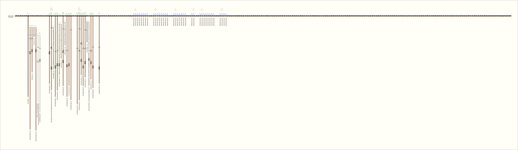
| KH0033 (AS031, UR1031, UR044) |
 |
| Pendant Pendant Sum |
 |
| Colored Pendant Sum |
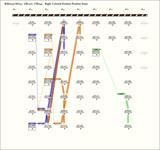 |
| Subsidiary Pendant Sum |
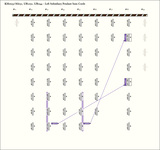 |
| Group Sum Bands |
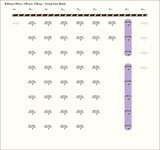 |
| Ascher Decreasing Group |
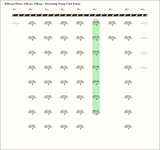 |
| DataFile: |
KH0033
|
| Notes: |
Ascher Databook Notes:
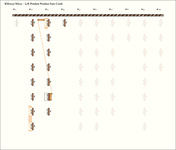
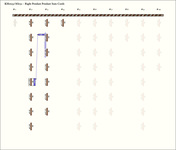
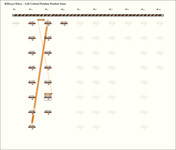
- This khipu can be viewed as six groups of 8 pendants (assuming that it is the 4th pendant in the 5th group that is not present) with 3 additional pendants (1, 41, 42) and a final group of 4 blank pendants (51-54). Referring to them as groups 1, 2, 3, 4, 5, 6, the following regularities are noted:
- All pendants in a group are the same color. Group 5 is LB/W and the rest are W.
- For all 6 groups, there are subsidiaries on pendants 2 and 5.
- For all 6 groups, the values of pendants 2 and 5 are between 77 and 158 while the values of the other six pendants are each less than 59. When subsidiary values are added to pendant values, the values of positions 2 and 5 are increased so that they are between 120 and 163(+?), but the values of the other 6 positions remain less than 59. Alternate groups show similarities:
- For groups 1, 3, 5: P5 > P2 > P4 ≥ P3 > {P7,P8 ; Pl=8}
- While for groups 2, 4, 6: P2 > P5 > P3 > P4; P4=16
- For groups 3, 5: Pl=8 ; P2=77; P5=83
- While for groups 4, 6: P4=16; P5=90; P6=4
- There seem to be an excessive number of values that are multiples of 8 or 11. Of forty-four unbroken, nonzero pendant values, 12 are multiples of 8, and 8 are multiples of 11. When subsidiary values and pendant values are considered, of sixty-five values, fifteen are multiples of 8 and twelve are multiples of 11. The multiples of 8 that appear are 8, 16, 24, 3 2, 40, and 120. The multiples of 11 are 11, 33, 44, 55, 77, and 132.
|
| Bibliography: |
Bibliography for KH0033 (AS031, UR1031, UR044):
| Year |
Author |
Title |
Pages |
| 1978 |
Ascher, Marcia, and Robert Ascher. |
Code of the Quipu: Databook. University Microfilms, Ann Arbor. |
Text: 118-123 |
| 1981 |
Ascher, Marcia, and Robert Ascher. |
Code of the Quipu: A Study in Media, Mathematics, and Culture. University of Michigan Press, Ann Arbor. |
Text: 121 |
| 1983 |
Ascher, Marcia. |
The Logical-Numerical System of Inca Quipus. Annals of the History of Computing 5:268–278. DOI: 10.1109/MAHC.1983.10090 |
Figures: fig.3 (p.272) |
| 2007 |
Cabrera Ibarra, Hugo; Rosu Barbus, Haret C.; Torres González, Luis A. & Treviño Gutiérrez, J. Pablo. "La codificación de los Quipus incas". Ciencia : Revista de la Academia Mexicana de Ciencias. |
). |
Figures: 32 |
| 2014 |
Cherkinsky, Alexander, and Gary Urton. |
Radiocarbon Chronology of Andean Khipus. Open Journal of Archaeometry 2(5260):32-36. |
Text: 34 |
| 2024 |
FitzPatrick, Mackinley. |
Misadventures with Khipu Naming Conventions. In Situ: News and Events of the Harvard Standing Committee on Archaeology, Spring 2024:20-24. |
Text: 24; Figures: fig.6,7 (p.24) |
| 1994 |
Katz, Victor J. |
Ethnomathematics in the classroom. For the Learning of Mathematics 14(2):26-30. |
Figures: 30 |
| 1999 |
Pacheco Ríos, Oscar. |
Del quipu incaico a la yupana : el computador ancestral. Santa Cruz de la Sierra, Bolivia: Editorial CEPDI. |
Figures: 10 |
| 2006 |
Searle Hernández, Guillermo. "Las primeras anudaciones: el quipo y la yupana, antecesores históricos de los ordenadores en el Imperio Inca: los quipocamayocs, “funcionarios informáticos” incas". Boletic. |
). |
Figures: 101 |
| 1995 |
Stone-Miller, R. |
Art of the Andes: From Chavín to Inca. Thames & Hudson. |
Figures: 185 |
| 2011 |
Urton, Gary, and Carrie J. Brezine. |
Khipu Typologies. In Their Way of Writing: Scripts, Signs, and Pictographies in Pre-Columbian America, edited by Elizabeth Hill Boone and Gary Urton, pp. 319–352. Dumbarton Oaks Research Library and Collection, Washington. |
Text: 348 |
| 2017 |
Urton, Gary. |
Inka History in Knots: Reading Khipus as Primary Sources. University of Texas Press, Austin. |
Text: 263 |
| 1966 |
Willey, Gordon R. |
An Introduction to American Archaeology: South America, Vol. 2. Prentice-Hall, New Jersey. |
Figures: fig.3.122 (p.183) |
| 2007 |
Witkowski, Olaf. |
Essai de décryptage des cordelettes quipus utilisées par les Incas comme moyen de communication: Un exemple d’ethno-cryptographie (Doctoral dissertation, Master’s thesis, Université Catholique de Louvain). |
Text: 97 |
|