| Section |
Information |
| Statistics: |
Aliases: AS153
Contributors: Marcia & Robert Ascher
Museum: Museum für Völkerkunde (Ethnologische Museum), Berlin, Germany
Museum Number: VA66831
Provenance: Unknown
Region: Unknown
|
# of Groups & Cords: 3 Groups, 40 Cords - (21p, 19s)
# of Unique Cord Colors: 7
Benford Match: 0.8771
# Ascher Sums (pps, ips, cps, sps,...): 6 (3, 0, 1, 2,...)
Similar Khipu: Previous (KH0147) Next (KH0385)
|
|
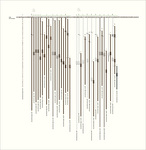
| KH0169 (AS153) |
 |
| Pendant Pendant Sum |
 |
| Colored Pendant Sum |
 |
| Subsidiary Pendant Sum |
 |
| DataFile: |
KH0169
|
| Notes: |
Ascher Databook Notes:
- Construction note: The end of the main cord is bent back and inserted through the strands of the cord.
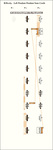
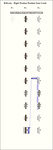
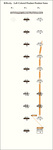
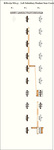
- Both groups of 10 pendant cords have the same color patterning. Each is subdivided into subsets of 6, 2, 2 pendants each. In Group 1 these are BB, BB-W, BB, while in Group 2 they are W, BB-W, W. In both groups, where there is one subsidiary on a pendant cord it is BB and where there is a second subsidiary it is LB in Group 1 and LC in Group 2.
- In both groups:
- the value of pendant 2 equals the value of pendant 4;
- the value of pendant 5 equals the value of pendant 6; and
- the value of pendant 3 equals 3
- In Group 1, the sum of the values on the BB colored pendants equals the sum of the values on the BB colored subsidiaries.
- In both groups the last ( tenth) pendant is related to the sums of the other pendants in the groups.
- In Group 1, the sum of all subsidiary values on pendants 1 to 8 equals the value on pendant 10.
- In Group 2, the sum of all subsidiary values on pendants 1 to 8 equals the value of the first subsidiary on pendant 10. The subsidiary value on pendant 9 equals the value of the second subsidiary on pendant 10. Hence, the sum of all subsidiary values on the first 9 pendants equals the sum of the subsidiary values on the tenth pendant.
- The sum of the first 9 pendant values in Group 1 equals the value of the tenth pendant in Group 2.
|
| Bibliography: |
Bibliography for KH0169 (AS153):
| Year |
Author |
Title |
Pages |
| 1978 |
Ascher, Marcia, and Robert Ascher. |
Code of the Quipu: Databook. University Microfilms, Ann Arbor. |
Text: 974-976 |
| 2005 |
Ascher, Marcia. |
How Can Spin, Ply, and Knot Direction Contribute to Understanding the Quipu Code? Latin American Antiquity 16(1):99–111. |
Text: 103-104 |
| 1994 |
Urton, Gary. |
New Twist in an Old Yarn: Variation in Knot Directionality in the Inka Khipus. Baessler-Archiv Neue Folge 42:271-305. |
Text: 288; Figures: 301 |
| 2003 |
Urton, Gary. |
Signs of the Inka Khipu: Binary Coding in the Andean Knotted-String Records. University of Texas Press, Austin. http://www.jstor.org/stable/10.7560/785397 |
Text: 82; Figures: fig.3.11 (p.82-83) |
| 2017 |
Urton, Gary. |
Inka History in Knots: Reading Khipus as Primary Sources. University of Texas Press, Austin. |
Text: 261 |
| 2007 |
Witkowski, Olaf. |
Essai de décryptage des cordelettes quipus utilisées par les Incas comme moyen de communication: Un exemple d’ethno-cryptographie (Doctoral dissertation, Master’s thesis, Université Catholique de Louvain). |
Text: 97 |
|