| Section |
Information |
| Statistics: |
Original Name: AS087/N3
Original Author: Gary Urton
Museum: Museum für Völkerkunde,
Museum Number: G3304
Provenance: Peru
Region: Unknown
|
# of Cords: 97 (89p, 8s)
# of Unique Cord Colors: 6
Benford Match: 0.9478
# Ascher Sums (pps, ips, cps, sps,...): 6 (0, 0, 6, 0,...)
Similar Khipu: Previous (UR150) Next (UR017)
|
|
| UR1087/KH0100 |
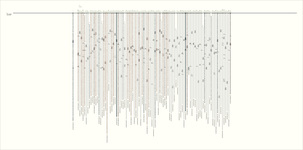 |
| Colored Pendant Sum |

 |
| DataFile: |
UR1087
|
| Notes: |
Ascher Databook Notes:
- No numerical interpretation is possible as the knot clusters do not conform to the base ten positional system. Nineteen different knot cluster orders are found on the pendants. These include long knots or figure eight knots followed by single knots, and long knots or single knots followed by long knots. Also,
there are 13 knots which contain 10, 11, 12, or 13 knots.
- Construction note: Several long knots of 2 or 3 are constructed in a reverse manner. (See diagram, AS095 construction note.)
- UR1097, UR1099, AS090/N2, AS092, AS093, AS094 are associated in that the Museum designates them all as donated by Gaffron. Peru is given as the provenance.
- UR1097 i s also discussed by Nordenskiold (see Introduction, Table 3).
- Comparison of UR1097, AS089, AS090/N2, AS092, AS093, AS094:
- UR1099 and AS092 are similar in colors. Each is basically 8 groups with a uniform number of pendants and a uniform color pattern.
- AS093 and AS094 are tied together but otherwise show little similarity.
-
- UR1097 differs markedly from the other 5 khipus. All its colors are different and it is the only one where different type knots appear in all different positions on the pendants. It is, however, similar to AS095, also donated by Gaffron.
|
| Bibliography: |
Bibliography for UR1087/KH0100:
| Year |
Author |
Title |
Pages |
| 1937 |
Altieri, Andrés R. |
El Kipu Peruano. Revista Geografica Americana 4(40):1-14. |
2 |
| 1978 |
Ascher, Marcia, and Robert Ascher. |
Code of the Quipu: Databook. University Microfilms, Ann Arbor. |
618-623; 669 |
| 2024 |
Hyland, Sabine. |
Knot Anomalies on Inka Khipus: Revising Locke’s Knot Typology. In IX International Conference on Pre-Columbian and Amerindian Textiles / 9th International Conference on Pre-Columbian and Amerindian Textiles, Museo delle Culture, Milan, 2022, pp. 162-180. Zea Books, Lincoln, Nebraska. |
172 |
| 1925 |
Kreichgauer, P. Dam. |
Bibliograpie: Nordenskiöld: The Secret of the Quipu. Anthropos 20:1193-1194. |
1193 |
| 1970 |
Mackey, Carol. |
Knot Records in Ancient and Modern Peru. PhD dissertation, Anthropology, University of California, Berkeley. |
48; 50; 211 |
| 1925 |
Nordenskiöld, Erland. |
The Secret of the Peruvian Quipus. Elanders, Gothenburg. |
17-20; 34 |
| 2020 |
Pancorvo Salicetti, Anel, (editor). Quipus y quipucamayoc: Codificación y administración en el antiguo Perú. Apus Graph Ediciones, Lima. |
Salicetti, Anel, (editor). Quipus y quipucamayoc: Codificación y administración en el antiguo Perú. Apus Graph Ediciones, Lima. |
416 |
| 1949 |
Radicati di Primeglio, Carlos. |
Introducción al estudio de los quipus. Documenta, Revista de la Sociedad Peruana de Historia 2(1):244-339. |
258 |
| 1964 |
Radicati di Primeglio, Carlos. |
La seriación como posible clave para descifrar losquipus extranumerales. In Estudios sobre los quipus, edited by Gary Urton, pp. 155–264. Universidad Nacional Mayor de San Marcos, Lima. |
215 |
| 1976 |
Radicati di Primeglio, Carlos. |
El sistema contable de los Incas: Yupana y Quipu. In Estudios sobre los quipus, edited by Gary Urton, pp. 265-354. Universidad Nacional Mayor de San Marcos, Lima. |
321; 350 |
| 2017 |
Urton, Gary. |
Inka History in Knots: Reading Khipus as Primary Sources. University of Texas Press, Austin. |
262 |
|