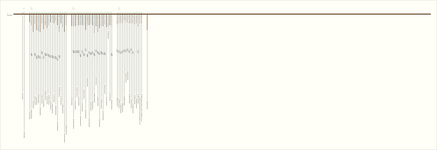
| Statistics: |
Original Name: AS097
Original Author: Marcia & Robert Ascher
Museum: Museum für Völkerkunde,
Museum Number: VA42553
Provenance: Pachacamac
Region: Unknown
|
# of Cords: 64
# of Unique Cord Colors: 7
Benford Match: 0.6356
# Ascher Sums (pps, ips, cps, sps,...): 0 (0, 0, 0, 0,...)
Similar Khipu: Previous (AS139) Next (AS065B)
|
|
| Notes: |
Ascher Databook Notes:
- Pendants 62 and 63 are tied together at 25.5 cm.
- Construction note: The colors of the pendants have been constructed by threading W pendants with other colors for the first 4.0-9.0 cm. of the pendant cord. Thus, near the main cord, the pendants differ in color but near the bottom they are all W.
- This is one of several khipus acquired by the Museum in 1907 with provenance Pachacamac. The khipus with this designation are UR1097, UR1099, AS101 - Part 2-UR1102, AS104, AS110-AS112, UR1118-UR1119, UR1121, AS125, UR1131, AS134, AS139, UR1144-UR1145, UR1151, AS156, AS158, UR1163, UR1165, UR1167, AS170, AS172, AS187-AS189.
- By spacing, the khipu is separated into 4 groups of 2, 22, 24, and 15 pendants followed by a single pendant. Both pendants in group 1 are W and all in group 4 are BB:W/W. The color patterns in groups 2 and 3 can be expressed in several different ways. One way is let:
- A denote the color pair G0:W/W, VB:W/W; A' the pair B/W, VB:W/W;
- B denote the color pair G0:W/W, BG:W/W; B' is B/W, BG:W/W;
- C denote the color pair G0:W/W, 0D:W/W; C' is B/W, 0D:W/W
Then group 2 has the pattern (ABABA) (BBABB) (BB) and group 3 has the pattern (CC'AC'C') (B') (BBABB)
- The values on the khipu are restricted to 0, 1, 2, 4, 5.
In group 1, both values are 0. In group 4, there are only values of 0 and 1.
Groups 2 and 3 share the property that many of the values are 1 and 5 alternately. Specifically:
\[ P_{2,2i} = 5\;for\;\;i\;=\;(1,...,9) \]
\[ P_{3,2i} = 5\;for\;\;i\;=\;(1,...,10) \]
\[ P_{2,2i-1} = 1\;for\;\;i\;=\;(4,..,9) \]
\[ P_{3,2i-1} = 1\;for\;\;i\;=\;(4,...,10) \]
|
| Bibliography: |
Bibliography for UR1097/KH0110:
| Year |
Author |
Title |
Pages |
| 1978 |
Ascher, Marcia, and Robert Ascher. |
Code of the Quipu: Databook. University Microfilms, Ann Arbor. |
676-681 |
| 1983 |
Ascher, Marcia. |
The Logical-Numerical System of Inca Quipus. Annals of the History of Computing 5:268–278. DOI: 10.1109/MAHC.1983.10090 |
276-277 |
| 1986 |
Ascher, Marcia. |
Mathematical Ideas of the Incas.’ In Native American Mathematics, edited by Michael P. Closs, pp. 261–289. University of Texas Press, Austin. |
283 |
| 2014 |
Cherkinsky, Alexander, and Gary Urton. |
Radiocarbon Chronology of Andean Khipus. Open Journal of Archaeometry 2(5260):32-36. |
34 |
| 2020 |
Pancorvo Salicetti, Anel, (editor). Quipus y quipucamayoc: Codificación y administración en el antiguo Perú. Apus Graph Ediciones, Lima. |
Salicetti, Anel, (editor). Quipus y quipucamayoc: Codificación y administración en el antiguo Perú. Apus Graph Ediciones, Lima. |
434 |
| 2006 |
Pereyra Sánchez, Hugo. |
Descripción de los quipus del Museo de Sitio de Pachacamac. Consejo Nacional de Ciencia, Tecnología e Innovación Tecnológica, Lima. |
14 |
| 1994 |
Urton, Gary. |
New Twist in an Old Yarn: Variation in Knot Directionality in the Inka Khipus. Baessler-Archiv Neue Folge 42:271-305. |
297 |
| 2014 |
Urton, Gary. |
Quipus de Pachamac. Ministerio de Cultura, Lima. |
43 |
| 2017 |
Urton, Gary. |
Inka History in Knots: Reading Khipus as Primary Sources. University of Texas Press, Austin. |
123; 261 |
|