| Statistics: |
Original Name: AS100
Original Author: Marcia & Robert Ascher
Museum: Museum für Völkerkunde,
Museum Number: VA47070
Provenance: Ica
Region: Unknown
|
# of Cords: 73 (66p, 7s)
# of Unique Cord Colors: 6
Benford Match: 0.8131
# Ascher Sums (pps, ips, cps, sps,...): 26 (9, 2, 10, 3,...)
Similar Khipu: Previous (UR1146) Next (UR1114)
|
|
| Notes: |
Ascher Databook Notes:
- Construction note: The twisted end of cord 1 is linked through the twisted end of the main cord so that it dangles from the end of the main cord.
- This is one of several khipus acquired by the Museum in 1907 with provenance Ica. The khipus with this designation are UR1100, UR1103, UR1105, UR1109, AS115-UR1117, UR1120, UR1123, UR1126, AS129, UR1135, UR1138, UR1141-UR1143, UR1146, UR1150, UR1152, UR1161-UR1162B, AS164, UR1166, AS171, UR1179-UR1180.
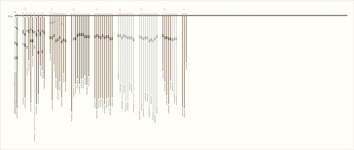
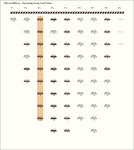
- By spacing, the khipu is separated into 3 parts. A single cord dangles from the end of the main cord, then part 1 is 1 group of 6 pendants, part 2 is 6 groups of 8-10 pendants each, and part 3 is 1 group of 3 pendants. Each pendant in part 1 has one subsidiary which is DB.
-
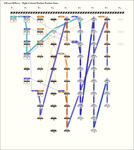
- The values of the 6 pendants in part 1 are the sums of the values of the 6 corresponding groups in part 2. (Four of the sums are exact, but on 2 of them, the values on the first and fifth pendants, are less than the group sums by 5 and 4 respectively.)
- The value of the first single cord is the sum of the values of the pendants in part 1. Similarly, the value on its subsidiary is the sum of the values on the subsidiary cords of part 1.
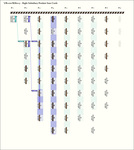
- In part 2, some of the sums of values in corresponding positions in the 6 groups are equal to each other. Some of the sums are equal to the sums of corresponding groups. Specifically:
\[ \sum\limits_{i=1}^6 P_{i2} = \sum\limits_{j=1}^{10} P_{2j} \]
\[ \sum\limits_{i=1}^6 P_{i4} = \sum\limits_{j=1}^9 P_{4j} \]
and
\[ \sum\limits_{i=1}^6 P_{i3} = \sum\limits_{i=1}^6 P_{i7} \]
\[ \sum\limits_{i=1}^6 P_{i5} = \sum\limits_{i=1}^6 P_{i6} \]
\[ \sum\limits_{i=1}^6 P_{i8} = \sum\limits_{i=1}^6 P_{i10} \]
|
| Bibliography: |
Bibliography for UR1100/KH0113:
| Year |
Author |
Title |
Pages |
| 2008 |
Artzi, Bat-Ami. |
El Secreto Del Nudo Del Khipu. Iberoamerica Global 2:34– 46. |
41 |
| 2009 |
Artzi, Bat-Ami. |
The secret of the knot: khipu No. 936 from the Maiman collection. Masters thesis, Hebrew University. |
59-60; 119-120; 121 |
| 2010 |
Artzi, Bat-Ami. The secret of the knot: khipu No. 936 from the Maiman collection. Estudios Latinoamericanos. |
Bat-Ami. The secret of the knot: khipu No. 936 from the Maiman collection. Estudios Latinoamericanos 30:187-214. |
202-203 |
| 1978 |
Ascher, Marcia, and Robert Ascher. |
Code of the Quipu: Databook. University Microfilms, Ann Arbor. |
694-698 |
| 1981 |
Ascher, Marcia, and Robert Ascher. |
Code of the Quipu: A Study in Media, Mathematics, and Culture. University of Michigan Press, Ann Arbor. |
15; 89 |
| 1986 |
Ascher, Marcia. |
Mathematical Ideas of the Incas.’ In Native American Mathematics, edited by Michael P. Closs, pp. 261–289. University of Texas Press, Austin. |
280 (ex.3) |
| 1998 |
Assadourian, Carlos Sempat. |
La creación del quipu con las cuerdas de los precios. In Narrative Threads: Accounting and Recounting in Andean Khipu, edited by Jeffrey Quilter and Gary Urton, pp. 119-150. University of Texas Press, Austin. |
127 |
| 2014 |
Cherkinsky, Alexander, and Gary Urton. |
Radiocarbon Chronology of Andean Khipus. Open Journal of Archaeometry 2(5260):32-36. |
34 |
| 2004 |
Salomon, Frank. |
The Cord Keepers: Khipus and Cultural Life in a Peruvian Village. Duke University Press, Durham, NC. |
19 |
| 1994 |
Urton, Gary. |
New Twist in an Old Yarn: Variation in Knot Directionality in the Inka Khipus. Baessler-Archiv Neue Folge 42:271-305. |
298 |
| 1997 |
Urton, Gary, and Primitivo Nina Llanos. |
The Social Life of Numbers: A Quechua Ontology of Numbers and Philosophy of Arithmetic. University of Texas, Austin. |
189 |
| 2006 |
Urton, Gary. |
Censos registrados en cordeles con ‘amarres’: Padrones poblacionales pre-hispánicos y coloniales tempranos en los khipu Inka. Revista Andina 42:153–196. |
164; 166; 170; 171 |
| 2011 |
Urton, Gary, and Carrie J. Brezine. |
Khipu Typologies. In Their Way of Writing: Scripts, Signs, and Pictographies in Pre-Columbian America, edited by Elizabeth Hill Boone and Gary Urton, pp. 319–352. Dumbarton Oaks Research Library and Collection, Washington. |
345 |
| 2017 |
Urton, Gary. |
Inka History in Knots: Reading Khipus as Primary Sources. University of Texas Press, Austin. |
261 |
| 1989 |
Zuidema, R. Tom. |
A Quipu Calendar from Ica, Peru, with a Comparisonto the Ceque Calendar from Cuzco. In World Archaeoastronomy, edited by A. F. Aveni, pp. 341-351. Cambridge University Press, Cambridge. |
341; 342; 345-348 |
| 2011 |
Zuidema, R. Tom. |
Chuquibamba Textiles and Their Interacting Systems of Notation. In Their Way of Writing: Scripts, Signs, and Pictographies in Pre-Columbian America, edited by Elizabeth Hill Boone and Gary Urton, pp. 251-276. Dumbarton Oaks Research Library and Collection, Washington. |
256 |
| 2014 |
Zuidema, R. Tom. |
Hacer calendarios’ en quipus y tejidos: Los números y su rol en el registro simultáneo del orden sociopolítico y calendárico andino en el Cuzco, Chuquibamba y Collaguas. In Sistemas de notación inca: Quipu y Tocapu, edited by Carman Arellano Hoffmann, pp. 395-445. Ministerio de Cultura, Lima. |
397 |
|