| Section |
Information |
| Statistics: |
Original Name: AS140/N9
Original Author: Marcia & Robert Ascher
Museum: Museum für Völkerkunde,
Museum Number: VA16636
Provenance: Nazca
Region: Unknown
|
# of Cords: 192 (182p, 10s)
# of Unique Cord Colors: 7
Benford Match: 0.9673
# Ascher Sums (pps, ips, cps, sps,...): 207 (102, 40, 65, 0,...)
Similar Khipu: Previous (UR1135) Next (UR129)
|
|
| UR1140/KH0156 |
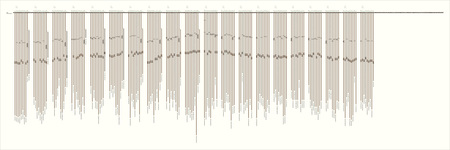 |
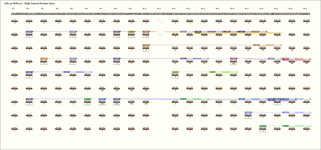
| Pendant Pendant Sum |
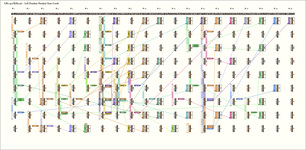
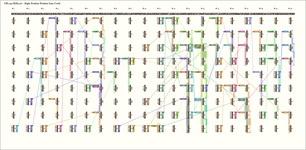 |
| Indexed Pendant Sum |
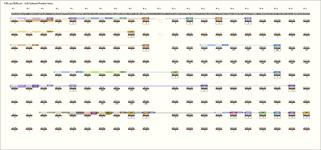
 |
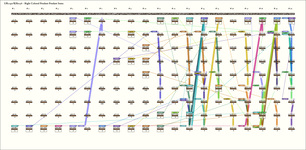
| Colored Pendant Sum |

 |
| DataFile: |
UR1140
|
| Notes: |
Ashok Khosla Notes:
This khipu has been entered with a strange nonconsecutive numbering scheme, indicating either the clusters are off, or the pendants are misnumbered.
Investigation into the databook is warranted.
Ascher Databook Notes:
- The khipu is attached to a carved wooden bar.
- UR1136 and UR1140 were acquired by the Museum in 1904. The provenance is given as Nasca. For a comparison of them, see UR1136.
- UR1140 is discussed by Nordenskiold (see Introduction) .A photograph of it appears in Schmidt, Max, 1929, Kunst und Kultur von Peru, Impropyläen-Verlagzu, Berlin.
- The way in which the bar is threaded separates the khipu into 2 parts each containing 10 groups of 9 pendants each
Note: The pendant order on the listing proceeds from one end of the bar to the other, goes around the end, and continues on the other side. However, similar color and number patterns are found in both parts if the pendants are read instead from one end of the bar to the other, and then beginning at the original end on the other side of the bar. We will, therefore, refer to the pendants and groups on side 2 as if following the second scenario. Part 1 is pendants 1--->90 and references to the jth pendant in the ith group correspond to pendant 9 (i-1) +j. Part 2 is pendants 180--->91 and references to the jth pendant in the ith group correspond to pendant 190-9i-j.
By color, each part is separated into 2 subparts of 6 groups and 4 groups respectively. Each group has the same color pattern: 5 B, 2 mixed, 2 B. In the first 6 groups in part 1, the 2 mixed cords are B:BB/B, and in the last 4 groups they are B:BB. In the first 6 groups in part 2, the 2 mixed cords are B:BB, and in the last 4 groups they are B:G.
- Subsidiaries are only on the last pendant in each group in part 1. All are BB.
- In all groups in both parts:
- The last pendant in each group has the maximum value.
- With the exception of group 10 in part 1, the value on pendant 7 is always great than the value on pendant 8.
- Within part 1:
- For the 6 groups of the first subpart, the sum of the values in the 5th position equals the sum of the values in the 4th position. That is:
\[ \sum\limits_{i=1}^{6} P_{i5} = \sum\limits_{i=1}^{6} P_{i6} \]
- For the 4 groups of the second subpart, the sum of the values in the first position equals the sum of the values in the second position.
\[ \sum\limits_{i=7}^{10} P_{i1} = \sum\limits_{i=7}^{10} P_{i2} \]
- Excluding the last pendant in each group, the sum of the values in the first group equals the sum of the values in the corresponding group in the second subpart (group 7).
\[ \sum\limits_{j=1}^{8} P_{1j} = \sum\limits_{j=1}^{8} P_{7j} \]
|
| Bibliography: |
Bibliography for UR1140/KH0156:
| Year |
Author |
Title |
Pages |
| 1999 |
Arellano Hoffmann, Carmen. |
Quipu y tocapu: Sistemas de comunicación inca. In Los Incas: Arte y símbolos, edited by Franklin Pease G. Y., Craig Morris, Julián I. Santillana, et al., pp. 215–261. Banco de Crédito del Perú, Lima. |
- |
| 1969 |
Ascher, Marcia and Robert Ascher. |
Code of ancient Peruvian knotted cords (Quipus). Nature 222(5193):529-533. |
531 |
| 1978 |
Ascher, Marcia, and Robert Ascher. |
Code of the Quipu: Databook. University Microfilms, Ann Arbor. |
9; 893; 896; 903-915 |
| 1981 |
Ascher, Marcia, and Robert Ascher. |
Code of the Quipu: A Study in Media, Mathematics, and Culture. University of Michigan Press, Ann Arbor. |
15; 96 |
| 1988 |
Ascher, Marcia, and Robert Ascher. |
Code of the Quipu: Databook II. University Microfilms, Ann Arbor, Michigan. |
9 |
| 1986 |
Ascher, Marcia. |
Mathematical Ideas of the Incas.’ In Native American Mathematics, edited by Michael P. Closs, pp. 261–289. University of Texas Press, Austin. |
286 |
| 2005 |
Ascher, Marcia. |
How Can Spin, Ply, and Knot Direction Contribute to Understanding the Quipu Code? Latin American Antiquity 16(1):99–111. |
102; 103 |
| 1951 |
Barthel, Thomas S. |
Bemerkungen zu einem astronomischen Quipu aus Südperu. Ethnos 16(3-4):153-170. DOI: 10.1080/00141844.1949.9980739 |
throughout |
| 2016 |
Hyland, Sabine. |
How Khipus Indicated Labour Contributions in an Andean Village: An Explanation of Colour Banding, Seriation and Ethnocategories. Journal of Material Culture 21(4):490-509. |
492 |
| 1925 |
Kreichgauer, P. Dam. |
Bibliograpie: Nordenskiöld: The Secret of the Quipu. Anthropos 20:1193-1194. |
1194 |
| 1926 |
Kreichgauer, P. Dam. |
Das Rätsel der Quipus. Anthropos 21:618-620. |
618; 619; 620 |
| 1927 |
Lenoir, Raymond. |
Le soulava et le quipo. Revue de l’Institut de Sociologie 7(3):477-526. |
519-520; 521 |
| 1998 |
Loza, Carmen Beatriz. |
Du Bon Usage Des Quipus Face à l’administrationColoniale Espagnole (1550-1600). Population 53 (1/2):139–159. https://doi.org/10.2307/1534240. |
- |
| 1970 |
Mackey, Carol. |
Knot Records in Ancient and Modern Peru. PhD dissertation, Anthropology, University of California, Berkeley. |
42; 211 |
| 1925 |
Nordenskiöld, Erland. |
Calculations with Years and Months in the Peruvian Quipus. Elanders, Gothenburg. |
12-15; 16; 30-31 |
| 1949 |
Radicati di Primeglio, Carlos. |
Introducción al estudio de los quipus. Documenta, Revista de la Sociedad Peruana de Historia 2(1):244-339. |
253; 257 |
| 1976 |
Radicati di Primeglio, Carlos. |
El sistema contable de los Incas: Yupana y Quipu. In Estudios sobre los quipus, edited by Gary Urton, pp. 265-354. Universidad Nacional Mayor de San Marcos, Lima. |
330; 351 |
| 2013 |
Salomon, Frank. |
The Twisting Paths of Recall: Khipu (Andean cord notation) as artifact. In Writing as Material Practice: Substance, surface and medium, edited by Kathryn E. Piquette and Ruth D. Whitehouse, pp. 15-43. Ubiquity Press, London. DOI: http://dx.doi.org/10.5334/bai.b |
35 |
| 1929 |
Schmidt, Max. |
Kunst und Kultur von Peru. Impropylaen-Verlagzu, Berlin |
97-98 |
| 1994 |
Urton, Gary. |
New Twist in an Old Yarn: Variation in Knot Directionality in the Inka Khipus. Baessler-Archiv Neue Folge 42:271-305. |
299 |
| 2017 |
Urton, Gary. |
Inka History in Knots: Reading Khipus as Primary Sources. University of Texas Press, Austin. |
131-136; 261 |
|