| Section |
Information |
| Statistics: |
Original Name: AS143
Original Author: Marcia & Robert Ascher
Museum: Museum für Völkerkunde, Berlin, Germany
Museum Number: VA47096
Provenance: Ica
Region: Unknown
|
# of Cords: 30
# of Unique Cord Colors: 6
Benford Match: 0.9114
# Ascher Sums (pps, ips, cps, sps,...): 5 (0, 2, 3, 0,...)
Similar Khipu: Previous (UR1120) Next (UR1118)
|
|
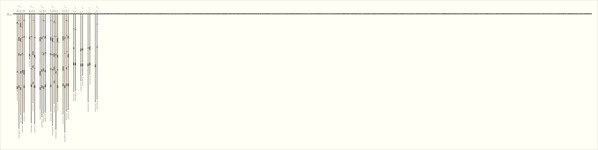
| UR1143/KH0159 |
 |
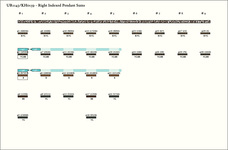
| Indexed Pendant Sum |
 |
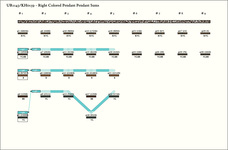
| Colored Pendant Sum |
 |
| DataFile: |
UR1143
|
| Notes: |
Ascher Databook Notes:
- This is one of several khipus acquired by the Museum in 1907 with provenance Ica. For a list of them, see UR1100.
- By spacing, the khipu is separated into 2 parts. The first part is 5 groups of 4 or 5 pendants each and the second part is 4 groups of 2 pendants each.
- In part 1:
- Each group has the same 5-color pattern: B:YG, BB:YG, B, BB,YG. Where there are only 4 pendants, it is the 4th position that is non-existent.
- The values in the first group are the sums, position by position, of the values in the other 4 groups.
\[ P_{1j} = \sum\limits_{i=2}^{5} P_{ij}\;\;\;for\;j=(1,2,3,4,5) \]
- The values within each group have the same relative magnitudes. Specifically
Pi3 > Pi1 > Pi5 > Pi2 > Pi4 for i=(1,2,3,4,5)
- From group to group, corresponding positions have the same relative magnitudes. With 1 exception
P1j > P4j > P3j ≥ P5j > P2j for j=(1,2,3,4,5)
- In part 2:
- Each group has the same 2-color pattern: B:YG, BB:YG. These are the first 2 colors of the 5-color pattern of part 1.
- Every value is less than the values in part 1.
- The value on pendant 3 (97357) is probably the largest value on any khipu in this Databook.
|
| Bibliography: |
Bibliography for UR1143/KH0159:
| Year |
Author |
Title |
Pages |
| 2009 |
Artzi, Bat-Ami. |
The secret of the knot: khipu No. 936 from the Maiman collection. Masters thesis, Hebrew University. |
53-54 |
| 1978 |
Ascher, Marcia, and Robert Ascher. |
Code of the Quipu: Databook. University Microfilms, Ann Arbor. |
698; 921-924 |
| 1981 |
Ascher, Marcia, and Robert Ascher. |
Code of the Quipu: A Study in Media, Mathematics, and Culture. University of Michigan Press, Ann Arbor. |
89; 144-145 (ex.7.6) |
| 1983 |
Ascher, Marcia. |
The Logical-Numerical System of Inca Quipus. Annals of the History of Computing 5:268–278. DOI: 10.1109/MAHC.1983.10090 |
275-276 |
| 2005 |
Ascher, Marcia. |
How Can Spin, Ply, and Knot Direction Contribute to Understanding the Quipu Code? Latin American Antiquity 16(1):99–111. |
101 |
| 2010 |
Chirinos Rivera, Andrés. |
Quipus del Tahuantinsuyo: Curacas, Incas y su saber matemático en el siglo XVI. Editorial Commentarios, Lima. |
238; 276; 286-293; 340 |
| 1996 |
Christensen, Antje. |
The Peruvian quipu. In History and science of knots, edited by J. C. Turner and P. van de Griend, pp. 71-88. World Scientific, New Jersey. |
83-84 |
| 2021 |
Medrano, Manuel. |
Knot Just Numbers: Mathematics and More in Andean Khipu Strings. Manuscript. |
6 |
| 1996 |
Pereyra S., Hugo. |
Acerca de dos quipus con características numéricas excepcionales. Bulletin de l’Institut francais d’études Andins 25(2):203-231. |
188; 193-202 |
| 2006 |
Pereyra Sánchez, Hugo. |
Descripción de los quipus del Museo de Sitio de Pachacamac. Consejo Nacional de Ciencia, Tecnología e Innovación Tecnológica, Lima. |
21 |
| 2024 |
Thompson, Karen M. |
A Numerical Connection Between Two Khipus. Ñawpa Pacha, pp.1-22. |
20 |
| 1994 |
Urton, Gary. |
New Twist in an Old Yarn: Variation in Knot Directionality in the Inka Khipus. Baessler-Archiv Neue Folge 42:271-305. |
298 |
| 2017 |
Urton, Gary. |
Inka History in Knots: Reading Khipus as Primary Sources. University of Texas Press, Austin. |
261 |
|