| Section |
Information |
| Statistics: |
Original Name: AS146/N10
Original Author: Marcia & Robert Ascher
Museum: Museum für Völkerkunde,
Museum Number: VA47081
Provenance: Ica
Region: Unknown
|
# of Cords: 123 (110p, 13s)
# of Unique Cord Colors: 6
Benford Match: 0.9096
# Ascher Sums (pps, ips, cps, sps,...): 21 (1, 0, 18, 1,...)
Similar Khipu: Previous (UR127) Next (UR1100)
|
|
| UR1146/KH0162 |
 |
| Pendant Pendant Sum |
 |
| Colored Pendant Sum |

 |
| Subsidiary Pendant Sum |
 |
| Group Sum Bands |
 |
| DataFile: |
UR1146
|
| Notes: |
Ascher Databook Notes:
- Construction note: The positioning of the knot clusters is not standard. Rather than having all long knot clusters aligned and all single knot clusters aligned, the first knot cluster used is in the highest position. Values have been assigned assuming that the knot cluster positions are "top justified" rather than the usual which is "bottom justified." For example, we usually write numbers "right justified" but can write them "left justified" also. Thus:
541|
23|
47|
left justified
or
|541
|23
|47
right justified
- Construction note: The markers are threads wrapped around the main cord. The wrapping extends for about 0.5 cm. along the main cord.
- This is one of several khipus acquired by the Museum in 1907 with provenance Ica. For a list of them, see UR1100.
- The positioning of knot clusters discussed in #1 above, is also found on AS164. (AS164 has the same Museum acquisition designation.)
- This khipu is also discussed by Nordenskiöld (see Introduction).
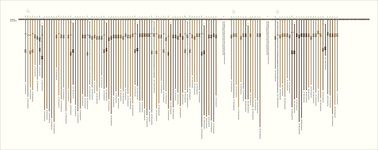
- By markers, the khipu is separated into 3 parts. The first part is 72 pendants alternating 6 YB, 6 B, 6 YB, 6 B, etc. Thus, by color, part 1 is 12 groups of 6 pendants each, Although not as consistent in color patterning, part 2 is 2 groups of 6 pendants each (6 YB, 6 mixed), and part 3 is 4 groups of 6 pendants each (6 YB, 6 DB, 6 YB, 6 mixed).
- Subsidiaries appear only on the first position in a group. When attached to YB pendants they are CB: W, and when attached to other colors they are BB.
- The values on the khipu are restricted to 0-17, and 64.
- The sum of the values on all pendants in part 1 is 500.
|
| Bibliography: |
Bibliography for UR1146/KH0162:
| Year |
Author |
Title |
Pages |
| 1969 |
Ascher, Marcia and Robert Ascher. |
Code of ancient Peruvian knotted cords (Quipus). Nature 222(5193):529-533. |
531 |
| 1978 |
Ascher, Marcia, and Robert Ascher. |
Code of the Quipu: Databook. University Microfilms, Ann Arbor. |
698; 936-942; 1009 |
| 1981 |
Ascher, Marcia, and Robert Ascher. |
Code of the Quipu: A Study in Media, Mathematics, and Culture. University of Michigan Press, Ann Arbor. |
68 |
| 1925 |
Kreichgauer, P. Dam. |
Bibliograpie: Nordenskiöld: The Secret of the Quipu. Anthropos 20:1193-1194. |
1194 |
| 1926 |
Kreichgauer, P. Dam. |
Das Rätsel der Quipus. Anthropos 21:618-620. |
618; 619 |
| 1927 |
Lenoir, Raymond. |
Le soulava et le quipo. Revue de l’Institut de Sociologie 7(3):477-526. |
519-520 |
| 1970 |
Mackey, Carol. |
Knot Records in Ancient and Modern Peru. PhD dissertation, Anthropology, University of California, Berkeley. |
211 |
| 1925 |
Nordenskiöld, Erland. |
Calculations with Years and Months in the Peruvian Quipus. Elanders, Gothenburg. |
15-18; 27; 31 |
| 1976 |
Radicati di Primeglio, Carlos. |
El sistema contable de los Incas: Yupana y Quipu. In Estudios sobre los quipus, edited by Gary Urton, pp. 265-354. Universidad Nacional Mayor de San Marcos, Lima. |
321; 351 |
| 2017 |
Schmidt, Paulo, and José Luiz dos Santos. |
The application of Inca khipu as an accountability and managerial control tool. Revista Brasileira de Gestão de Negócios 19, pp. 613-626. |
- |
| 1994 |
Urton, Gary. |
New Twist in an Old Yarn: Variation in Knot Directionality in the Inka Khipus. Baessler-Archiv Neue Folge 42:271-305. |
298 |
| 2017 |
Urton, Gary. |
Inka History in Knots: Reading Khipus as Primary Sources. University of Texas Press, Austin. |
261 |
|