KH0105/AS092 - Colored Pendant Sums
Drawings:
Right Handed Sums: # Sums = 8, Max # Summands = 6, (Min, Mean, Max) Sum Values = (13, 31, 58)
Click on Image to View Larger

Left Handed Sums: # Sums = 3, Max # Summands = 4, (Min, Mean, Max) Sum Values = (17, 28, 45)
Click on Image to View Larger

Right Handed Sum Detail: - Click on column name to sort
| # | Color | Sum Schema | Sum Cord | Sum Cord Value | # Summands | Summands |
|---|---|---|---|---|---|---|
| 1 | 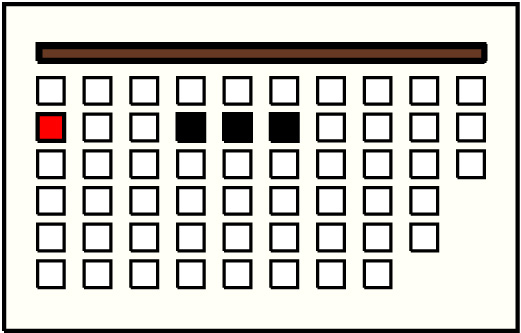 | g1p2 : 17MB | 17 | 3 | g4p2: 9MB + g5p2: 6MB + g6p2: 2MB | |
| 2 | 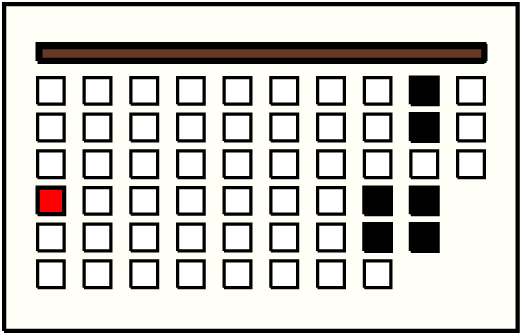 | g1p4 : 47W | 47 | 6 | g8p4: 4W + g8p5: 4W + g9p1: 15W + g9p2: 10W + g9p4: 10W + g9p5: 4W | |
| 3 | 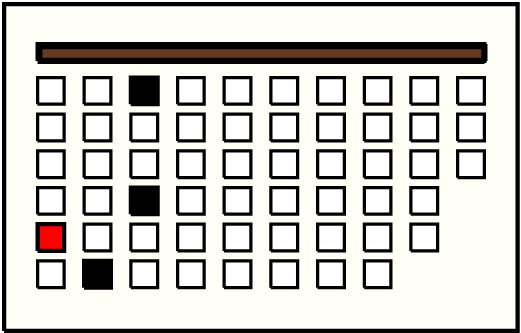 | g1p5 : 58W | 58 | 3 | g2p6: 4W + g3p1: 41W + g3p4: 13W | |
| 4 | 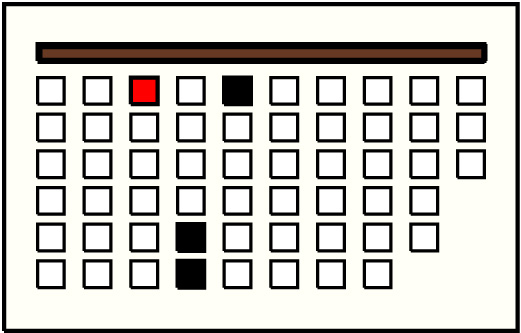 | g3p1 : 41W | 41 | 3 | g4p5: 17W + g4p6: 6W + g5p1: 18W | |
| 5 | 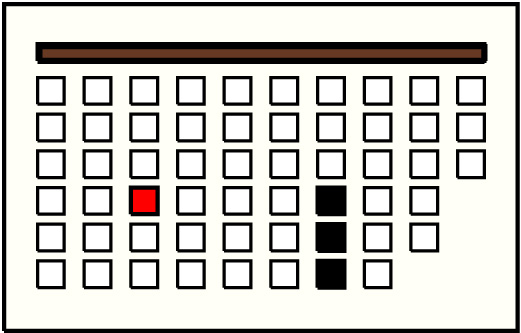 | g3p4 : 13W | 13 | 3 | g7p4: 7W + g7p5: 4W + g7p6: 2W | |
| 6 | 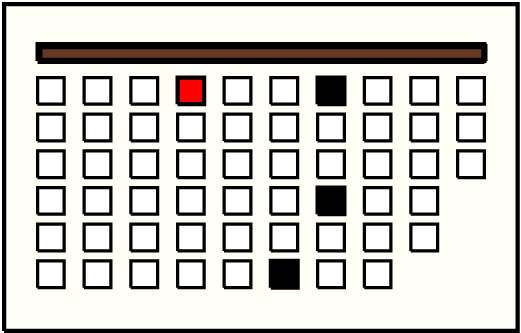 | g4p1 : 45W | 45 | 3 | g6p6: 6W + g7p1: 32W + g7p4: 7W | |
| 7 | 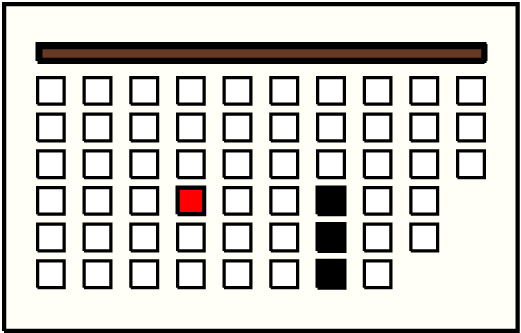 | g4p4 : 13W | 13 | 3 | g7p4: 7W + g7p5: 4W + g7p6: 2W | |
| 8 | 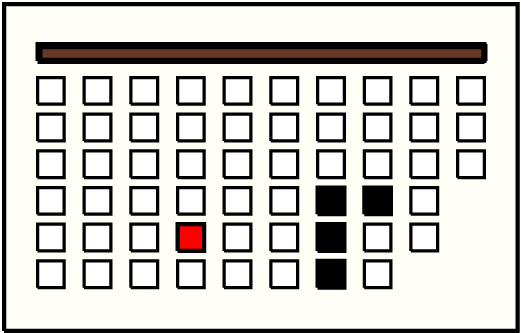 | g4p5 : 17W | 17 | 4 | g7p4: 7W + g7p5: 4W + g7p6: 2W + g8p4: 4W |
Left Handed Sum Detail: - Click on column name to sort
| # | Color | Sum Schema | Sum Cord | Sum Cord Value | # Summands | Summands |
|---|---|---|---|---|---|---|
| 1 | 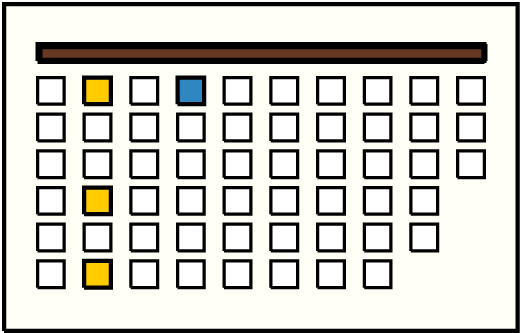 | g4p1 : 45W | 45 | 3 | g2p1: 38W + g2p4: 3W + g2p6: 4W | |
| 2 | 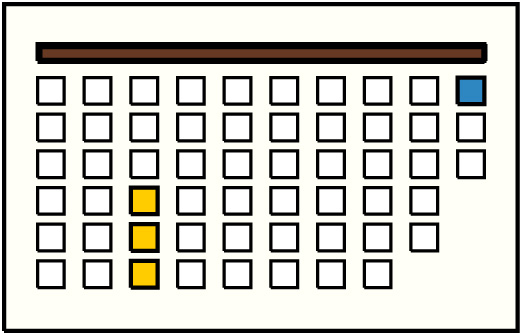 | g10p1 : 21W | 21 | 3 | g3p4: 13W + g3p5: 4W + g3p6: 4W | |
| 3 | 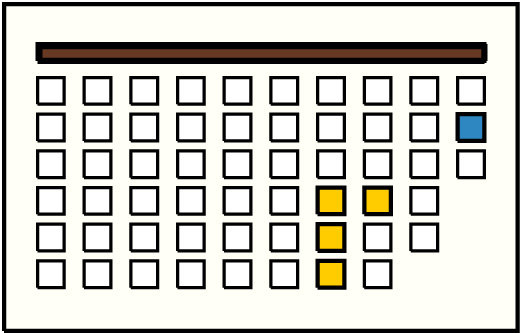 | g10p2 : 17W | 17 | 4 | g7p4: 7W + g7p5: 4W + g7p6: 2W + g8p4: 4W |
Khipu Notes:
Ascher Databook Notes:
- KH0100, KH0102, KH0103, KH0105, KH0106, KH0107 are associates in that the Museum designates them all as donated by Gaffron, and gives the provenance as Peru. For a comparison of them, see KH0100.
- By spacing, KH0105 is separated into 10 groups. The first 8 groups each have 6 pendants with the same color pattern (W, MB, MB:W, W, W, W).
- In all 10 groups, the first pendant has the maximum value.
- Position by position, the pendant values in group 1 are larger than those in group 4, which are larger than those in group 3, which are larger than those in group 2. That is:
\[ P_{1i} > P_{4i} > P_{3i} > P_{2i}\;for\;\;i\;=\;(2,3,4,...,8) \]
- In a few cases, the sums of values in the same position in pairs of consecutive groups are equal. Namely:
\[ P_{4i} + P_{5i} = P_{6i} + P_{7i}\;for\;\;i\;=\;(1,4) \]\[ P_{2i} + P_{3i} = P_{6i} + P_{7i}\;for\;\;i\;=\;(4,6) \]