KH0161/UR1145, AS145 - Colored Pendant Sums
Drawings:
Right Handed Sums: # Sums = 1, Max # Summands = 3, (Min, Mean, Max) Sum Values = (34, 34, 34)
Click on Image to View Larger

Left Handed Sums: # Sums = 1, Max # Summands = 5, (Min, Mean, Max) Sum Values = (21, 21, 21)
Click on Image to View Larger

Right Handed Sum Detail: - Click on column name to sort
| # | Color | Sum Schema | Sum Cord | Sum Cord Value | # Summands | Summands |
|---|---|---|---|---|---|---|
| 1 | 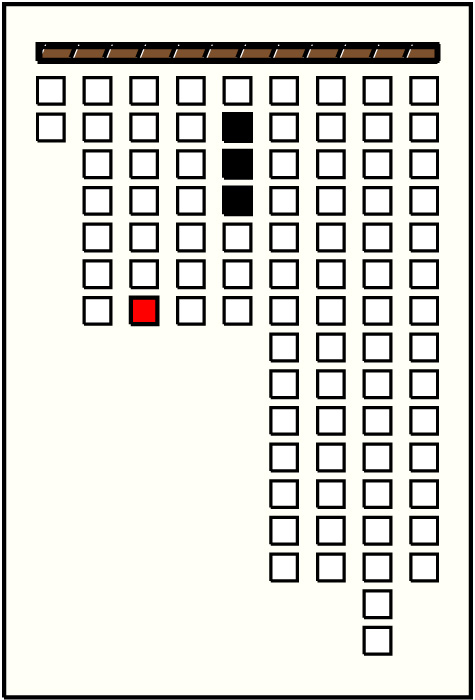 | g3p7 : 34DB | 34 | 3 | g5p2: 7DB + g5p3: 15DB + g5p4: 12DB |
Left Handed Sum Detail: - Click on column name to sort
| # | Color | Sum Schema | Sum Cord | Sum Cord Value | # Summands | Summands |
|---|---|---|---|---|---|---|
| 1 | 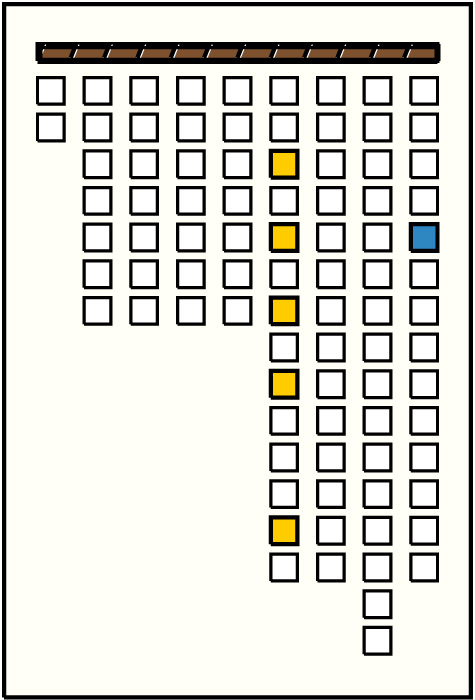 | g9p5 : 21LC | 21 | 5 | g6p3: 2LC + g6p5: 4LC + g6p7: 2LC + g6p9: 7LC + g6p13: 6LC |
Khipu Notes:
Ascher Databook Notes:
- A pendant fragment stored with the khipu was assumed to be part of pendant 37. Pendant 37 is broken at 16.0 cm.
- A pendant fragment stored with the khipu was assumed to be part of subsidiary 84s1 The subsidiary is broken at 10.5 cm.
- This is one of several khipus acquired by the Museum in 1907 with provenance Pachacamac. For a list of them, see KH0110.
- By spacing and color patterning, the khipu is separated in to 3 parts. The first part is one pair of pendants; the second is 4 groups of 7 pendants each; and the last part is 4 groups of 14 or 16 pendants each.
- The khipu has 2 different knot cluster arrangements. One is the standard arrangement involving single knot clusters and long knot clusters. The other arrangement is only long knot clusters in one or more of 3 distinct positions on a cord. For convenience, call the former S and the latter N. The S and N arrangements are alternated on the khipu. In part 2, pendants in groups 1 and 3 are all N while in groups 2 and 4, they are all S. In part 3, within each group, the pendants alternate N, S, N, S, etc. The color patterning reinforces the alternation: in part 2, in groups 1 and 3, all pendants are B and in groups 2 and 4, they are DB; in part 3, in the first 2 groups, the colors alternate LC, DB-W, and in the next 2 groups, they alternate LC or B, DB-W. Thus, the knot arrangements and colors alternate together so that the N arrangement is associated with B or LC and the S arrangement with DB or DB-W.
- Some of the values on the pendants in groups 1 and 3 of part 2 sum to each other. Two relationships are repeated for pendants 3 positions apart. Namely:
P3i + P3,i+1 = P1i for i=(1,4)
P3i + P1i = 2 P3,i-1 for i=(4,7)