KH0166/UR1150, AS150 - Colored Pendant Sums
Drawings:
Sum NetGraph - Click on image to view larger
 |
Sum Map - Click on image to view larger
 |
Sum Overlay: - Click on Image to View Large. Right-click and Save Image for Slide Presentations

Right Handed Sums with Figure-8-Knots: # Sums = 2, Max # Summands = 7, (Min, Mean, Max) Sum Values = (117, 296, 475)
Click on Image to View Larger

Right Handed Sum Detail: - Click on column name to sort
| # | Color | Sum Schema | Sum Cord | Sum Cord Value | # Summands | Summands |
|---|---|---|---|---|---|---|
| 1 | 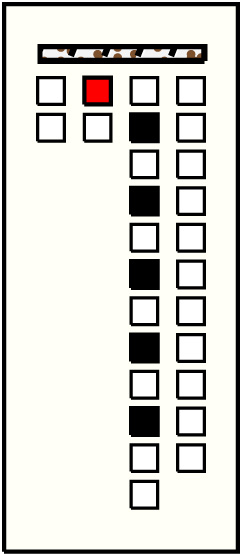 | g2p1 : 117RB | 117 | 5 | ❽g3p2: 65RB + g3p4: 38RB + g3p6: 10RB + g3p8: 2RB + g3p10: 2RB | |
| 2 |  | g2p2 : 475W | 475 | 7 | ∞g4p4: 57W∞ + g4p6: 73W + g4p7: 145W + g4p8: 67W + g4p9: 63W + g4p10: 37W + g4p11: 33W❽ |
Khipu Notes:
Ascher Databook Notes:
- The distance from $ to pendant 1 was not recorded. All main cord measurements begin at pendant 1.
- This is one of several khipus acquired by the Museum in 1907 with provenance Ica. For a list of them, see KH00110.
- By spacing, the khipu is separated into 4 groups of 2, 2, 12, and 11 pendants each. In the 3rd group, the pendant colors alternate W or B, RB; in the 4th group, they alternate B, W, for 3 pairs and then are all W. There are no subsidiaries in the 3rd group, and in the 4th group, there are 2 subsidiary positions. Where there is one subsidiary in the higher position, it is RB; where there are 2, they are RB, MB. Each subsidiary in the lower position is LB.
- The pendant values in groups 1 and 2 are related to the sums of the values in groups 3 and 4.
- The sum of the values on all W pendants in group 4 = the sum of the values on odd alternate positions in group 3 = the value on the second pendant in group 2.
- The sum of the values on all B pendants in group 4 = the value on the second pendant in group 1.
- The sum of the values on all RB subsidiaries in group 4 = the sum of the values on even alternate positions in group 3 • the value on the first pendant in group 2. (The group 3 sum has a discrepancy of 2.)
- The value on the first pendant in group 1 may equal the sum of the values on MB subsidiaries in group 4. The MB subsidiaries are broken and their's are the only unaccounted values.
- Assuming the above (d):
- The sum of the values on all pendants in group 3 = the sum of the values on the pendants in group 2.
- The sum of the values on all pendants and subsidiaries in group 4 = the sum of the values on the pendants in groups 1 and 2.