KH0164/UR1148, AS148 - Indexed Pendant Sums
Drawings:
Right Handed Sums: # Sums = 2, Max # Summands = 4, (Min, Mean, Max) Sum Values = (281, 804, 1327)
Click on Image to View Larger
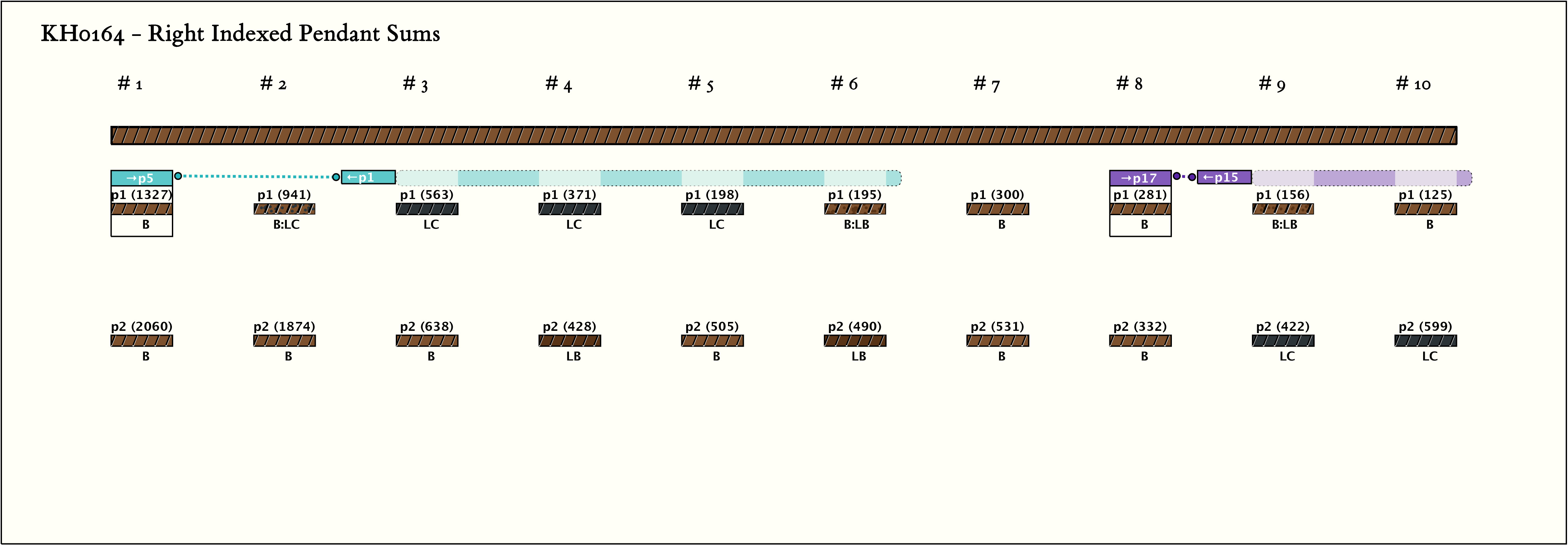
Right Handed Sum Detail: - Click on column name to sort
| # | Color | Sum Schema | Sum Cord | Sum Cord Value | # Summands | Summands |
|---|---|---|---|---|---|---|
| 1 | 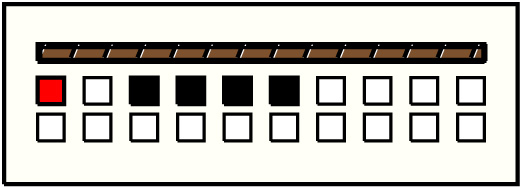 | g1p1 : 1327B | 1327 | 4 | g3p1: 563LC + g4p1: 371LC + g5p1: 198LC + g6p1: 195B:LB | |
| 2 | 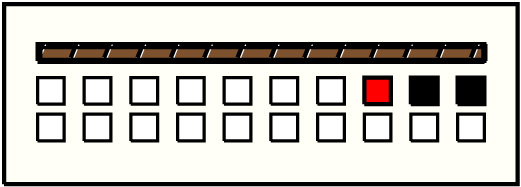 | g8p1 : 281B | 281 | 2 | g9p1: 156B:LB + g10p1: 125B |
Khipu Notes:
Ascher Databook Notes:
- KH0163-KH0165 are associated in that they were all designated by the same Museum number. They were acquired by the Museum in 1907 with provenance Ocucaje. For a comparison of them, see KH0163.
- By spacing, the khipu is separated into 3 parts. Part 1 is 2 pairs of pendants and parts 2 and 3 are eac h 4 pairs of pendants.
- The values in part 1 are the sums of values in parts 2 and 3. Assuming that the value of P2 is 2061 and the value of P13 is 379, with an exception of 1 in 1 digit, the first pair in part 1 are the sums, position by position, of the pairs in part 2, and the second pair in part 1 are the sums of the pairs in part 3, Namely:
\[ \sum\limits_{i=1}^{4} P_{2ij} = P_{11j}\;\;\;for\;j=(1,2) \]\[ \sum\limits_{i=1}^{4} P_{3ij} = P_{12j}\;\;\;for\;j=(1,2) \]where Pkij is the value of the pendant in the jth position of the ith group of the kth part. - In all 10 pairs, the value of the second pendant is larger than the first. It is also larger than the first value in the next pair. Thus:
P2i > P2i-1 i=(1,...,10) and
P2i > P2i+1 i=(1,...,9)
where Pi is the value of the ith pendant on the khipu.