| Statistics: |
Aliases: UR1166, AS166
Contributors: Marcia & Robert Ascher
Museum: Museum für Völkerkunde (Ethnologische Museum), Berlin, Germany
Museum Number: VA47079
Provenance: Ica
Region: Unknown
|
# of Groups & Cords: 21 Groups, 362 Cords - (222p, 140s)
# of Unique Cord Colors: 21
Benford Match: 0.4617
# Ascher Sums (pps, ips, cps, sps,...): 98 (28, 7, 11, 51,...)
Similar Khipu: Previous (KH0111) Next (KH0182)
|
|
| Notes: |
Ascher Databook Notes:
- Construction note: The twisted ends of the main cord and first cord are linked together. Cord 1 is shorter than the other pendants and bound with thread at its end.
2.Construction note: Subsidiaries attached to the first subsidiary on pendants 2, 24, 135, 157, 179, and 201 are attached in a non-standard way. They are looped around both the pendant and subsidiary to which they are connected.
- This is one of several khipus acquired by the Museum in 1907 with provenance Ica. For a list of them, see KH00110.
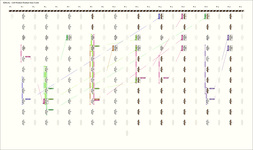
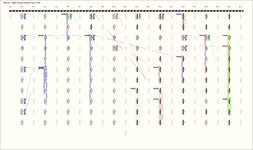
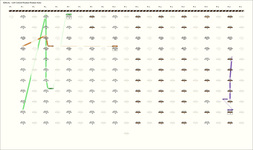
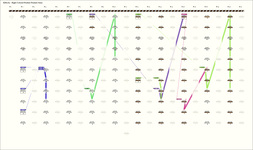
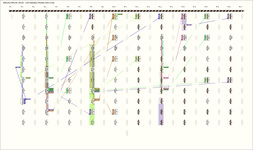
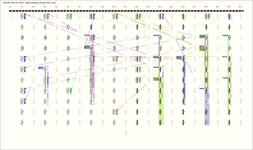
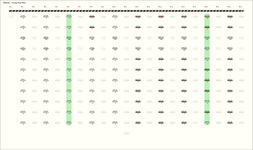
- Assuming that the first pendant and the last pendant in the 10th group are markers, the khipu is separated, by markers and spacing, into 2 parts of 10 groups each. Each group has 11 pendants.
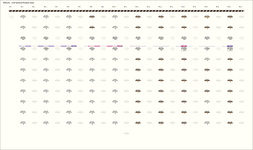
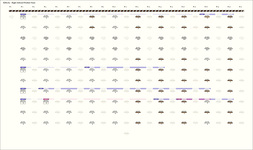
- With the exception of groups 7 and 17 (the 7 th group in each part), each group has the same patterning of colors: 2X, 2Y, 7X, Y is BB: W in all groups except groups 16 and 17 in which it is LC:W. The X varies so that the group colors alternate. In the first part (with the exception of 2 pendants in group 7), X is W in groups 1, 3, 5, 7, and 9 and it is LB in groups 2, 4, 6, 8, 10, In the second part: X is B in groups 11, 13, 15, 19; LB in 12, 14, 16; and YG in 18 and 20.
- In every even group (groups 2, 4, 6, ..., 18, 20), all pendants are zero-valued (or blank) and there are no subsidiaries.
- In every odd group (groups 1, 3, 5,..., 17, 19):
- Positions 4 and 11 have no subsidiaries; position 3 has 1 W subsidiary; and position 1 has 3-6 subsidiaries or subsidiaries of subsidiaries. The unusual attachment noted in #2 above only occurs in the first position. Other positions vary from 0-3 subsidiaries from group to group.
- Pendant 11 is always zero-valued (or blank).
- The value in position 1 is the maximum.
|
| Bibliography: |
Bibliography for KH0183 (UR1166, AS166):
| Year |
Author |
Title |
Pages |
| 1978 |
Ascher, Marcia, and Robert Ascher. |
Code of the Quipu: Databook. University Microfilms, Ann Arbor. |
Text: 698; 1012-1029; Figures: 1029 |
| 2005 |
Ascher, Marcia. |
How Can Spin, Ply, and Knot Direction Contribute to Understanding the Quipu Code? Latin American Antiquity 16(1):99–111. |
Text: 110 |
| 2020 |
Medelius Olcese de Riveros, Y.M., 2021. Dando cuentas: los quipucamayos en las comunidades indígenas y ante la administración colonial. Perú, siglo XVI. Doctoral Thesis. Universidad Pablo de Olavide de Sevill. |
Olcese de Riveros, Y.M., 2021. Dando cuentas: los quipucamayos en las comunidades indígenas y ante la administración colonial. Perú, siglo XVI. Doctoral Thesis. Universidad Pablo de Olavide de Sevilla |
Text: 122 |
| 1994 |
Urton, Gary. |
New Twist in an Old Yarn: Variation in Knot Directionality in the Inka Khipus. Baessler-Archiv Neue Folge 42:271-305. |
Text: 296 |
| 2017 |
Urton, Gary. |
Inka History in Knots: Reading Khipus as Primary Sources. University of Texas Press, Austin. |
Text: 261 |
| 2007 |
Witkowski, Olaf. |
Essai de décryptage des cordelettes quipus utilisées par les Incas comme moyen de communication: Un exemple d’ethno-cryptographie (Doctoral dissertation, Master’s thesis, Université Catholique de Louvain). |
Text: 97 |
|