| Statistics: |
Original Name: AS175
Original Author: Marcia & Robert Ascher
Museum: Museum für Völkerkunde,
Museum Number: VA42518
Provenance: Pachacamac
Region: Unknown
|
# of Cords: 338 (224p, 114s)
# of Unique Cord Colors: 10
Benford Match: 0.84
# Ascher Sums (pps, ips, cps, sps,...): 239 (103, 51, 48, 34,...)
Similar Khipu: Previous (UR1152) Next (UR1126)
|
|
| Notes: |
Ascher Databook Notes:
- This is one of several khipus acquired by the Museum in 1907 with provenance Pachacamac. For a list of them, see UR1097.
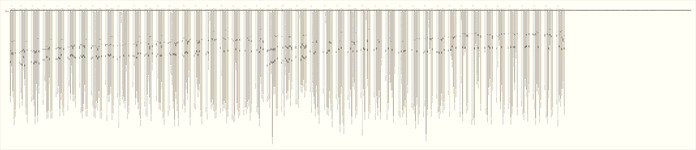
- By spacing, the khipu is separated into 45 groups of 5 pendants each. There is a larger space after every 3rd group and a still larger space between the 21st and 22nd groups and the 24th and 25th groups. Thus, the khipu is in 3 parts: part 1 is 7 sets of 3 groups each; part 2 is 1 set of 3 groups; and part 3 is 7 sets of 3 groups.
- All groups in part 1 have the same color pattern: W (with a W subsidiary); LB (with an LB subsidiary); YG; YB; YB: 0G. Groups in parts 2 and 3 have the same pattern for the first 3 pendant positions and then vary in one or both of the last 2 positions. Calling the colors in the part 1 pattern C1-C5, the color patterns are summarized in Table 1.
TABLE 1
| Part 1 (groups 1-21) | C1 | C2 | C3 | C4 | C5 |
| Part 2 (groups 1-3) | C1 | C2 | C3 | C4 | C4 |
| Part 3 (groups 1-5) | C1 | C2 | C3 | C2 | C5 |
| Part 3 (groups 6-8) | C1 | C2 | C3 | C2 | C4 |
| Part 3 (groups 9-21) | C1 | C2 | C3 | C4 | C4 |
In all groups, there is at least one subsidiary on pendants 1 and 2 (a W and an LB respectively) and no subsidiaries on the other positions. Additional subsidiaries on the first 2 positions are, with one exception, KB:W or LB-W.
- In parts 1 and 3, many values are repeated in the same position in consecutive groups or in the same position 2 groups later. The former can be represented as:,
Pij= Pi+1,j and the latter as Pij = Pi+2,j
In part 1, these hold in 20 and 12 places respectively; in part 2 in no places; and in part 3 in 27 and 18 places.
- The values in part 2 are related to the sums of values in part 3. Position by position, values in group 1 of part 2 are related to the sums of values in the first groups in each of the 7 sets in part 3; group 2 values are related to sums of values in the second groups of each of the sets; and group 3 values to the sums of values of the third group. That is:
\[ P_{2ij}= \sum\limits_{k=0}^{6} P_{3,3k+i,j}\;\;\;for\;j=(1,2,...5),\;\; i=(1,2,3) \]
This represents 15 sums and 105 values being summed. Of the 15 values in part 2, 8 are exactly these sums (or off by 1 in 1 digit); 5 are exact sums of only some of the 7 pendants:
Example: P211 = P341 + P3,10,1 + P3,13,1 + P3,16,1 + P3,19,1 thus omitting P311 and P371
and 2 are less than the sums but cannot be associated with a specific subset of the 7 pendants. (Note that the main cord is broken and so there could have been another part prior to part 1 that summed its values.
|
| Bibliography: |
Bibliography for UR1175/KH0192:
| Year |
Author |
Title |
Pages |
| 1978 |
Ascher, Marcia, and Robert Ascher. |
Code of the Quipu: Databook. University Microfilms, Ann Arbor. |
1057-1074 |
| 1981 |
Ascher, Marcia, and Robert Ascher. |
Code of the Quipu: A Study in Media, Mathematics, and Culture. University of Michigan Press, Ann Arbor. |
86; 91; 93 (ex.5.4) |
| 1983 |
Ascher, Marcia. |
The Logical-Numerical System of Inca Quipus. Annals of the History of Computing 5:268–278. DOI: 10.1109/MAHC.1983.10090 |
275 |
| 2005 |
Ascher, Marcia. |
How Can Spin, Ply, and Knot Direction Contribute to Understanding the Quipu Code? Latin American Antiquity 16(1):99–111. |
101; 108-109; 110 |
| 2006 |
Pereyra Sánchez, Hugo. |
Descripción de los quipus del Museo de Sitio de Pachacamac. Consejo Nacional de Ciencia, Tecnología e Innovación Tecnológica, Lima. |
14 |
| 1994 |
Urton, Gary. |
New Twist in an Old Yarn: Variation in Knot Directionality in the Inka Khipus. Baessler-Archiv Neue Folge 42:271-305. |
287; 297 |
| 2003 |
Urton, Gary. |
Signs of the Inka Khipu: Binary Coding in the Andean Knotted-String Records. University of Texas Press, Austin. http://www.jstor.org/stable/10.7560/785397 |
- |
| 2014 |
Urton, Gary. |
Quipus de Pachamac. Ministerio de Cultura, Lima. |
44 |
| 2017 |
Urton, Gary. |
Inka History in Knots: Reading Khipus as Primary Sources. University of Texas Press, Austin. |
123; 261 |
|