by Ashok Khosla and Agustín Da Fieno Delucchi, September 2026
1. Introduction
This study focuses on figure-8-knots, and the dual role they play, as knots with the value of 1, and as labels used by the khipu-kamayoq to communicate other semiotic information.
In the 1920s, Leland Locke Locke was the first khipu scholar to identify figure-8-knots. Locke’s analysis used the fact that top cords, when decoded, had values that were the sum of the cords in an adjacent cluster n.1. In Locke’s’typology - the “ones-column” - the rightmost digit, is represented by a figure-8-knot for 1, a long knot for the numbers 2-9. and no knot (knot absent) as a 0. By showing the role figure-8-knots played in sums Locke demonstrated they represented the value of 1. In the last century, Locke’s typology has largely been adopted as convention. Further study on the topological nature of Figure-8-Knot construction has been recently published by KFG Affiliate Mackinley FitzPatrick.
Since Locke’s original reading of Figure-8-Knots as the value of 1, others (Artzi, Urton&Brezine, Hyland, etc.) have suggested that figure-8-knots might also serve as semiotic labels. For example, Urton & Brezine suggest, in particular places in the Puruchuco khipus, that they might be a “toponym” (an indicator of a particular place).
1.1 Why is 1 Special?
Why would a khipu-kamayoq differentiate 1 with a special knot, rather than the same simple overhand knot used for 10s, 100s, etc.?
One stated argument is Chirality ([Urton 2003]) Single knots have all the important properties a figure-8-knot has such as chirality - dismissing the chirality argument. Similarly, - the “it’s nice to have a terminating knot” argument seems questionable, since there are a very large number of 10s , 50s, 100s valued cords, which have no special terminating knot. Overhand knots are both much easier and quicker to tie.
Other than the rationale that figure-8-knots have semiotic value, the only construction reason we can find, is that figure-8-knots are easier to untie than an overhand knot Ashley. We know from experience, calculating sums in the KFG (KhipuFieldGuide) database, that khipu-kamayoqs were frequently off-by-one in their sums, so perhaps this was an approach born of necessity.
When you examine the 700+ khipus in the KFG database, it becomes clear that figure-8-knots have a significant “signal” that they communicate, both by their exceptionally high occurrence, and by their clustering at “border locations” n.2. In particular, this study shows how figure-8-knots and Ascher Sums relate to each other.
1.2 Ascher Pendant Sum Types
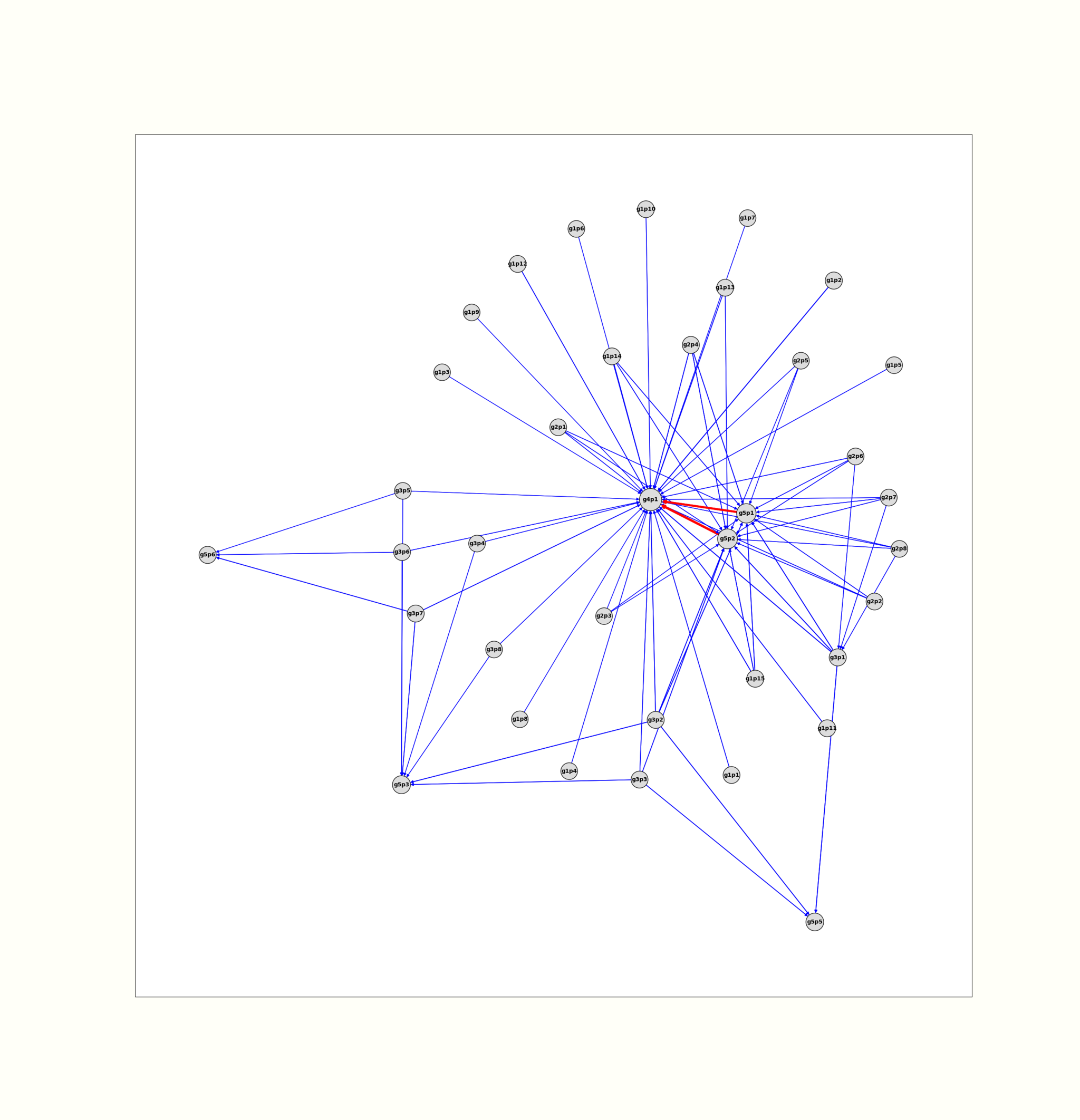
In 2025, Manuel Medrano and Ashok Khosla, extrapolated and generalized the most common summation relationships based on Marcia and Robert Aschers’ observations of khipus in their Databooks. Medrano and Khosla define Ascher Pendant Sums as a pendant cord that is the sum of a range of other pendants. Three common types of Sums exist, and they occur in two directions, Left versus Right. The three common types are Pendant Pendant Sums, Indexed Pendant Sums, and Colored Pendant Sums.
Pendant Pendant Sums are where the sum cord is the sum of the values of a set of contiguous summand cords, for example:
G1P1 = G3P5 + G4P1 + G4P2 (A subset of contiguous pendant cords from Group 3 and 4)
Indexed Pendant Sums are where the sum cord is the sum of the values of the indexed (position of the cord in its group) summand cords, for example:
G1P4 = G3P4 + G4P4 + G5P4 (Every 4th pendant from Groups 3,4, and 5)
Colored Pendant Sums are where the sum cord is the sum of the values of colored summand cords across groups, regardless of their position, for example:
G1PRed = G3PRed + G4PRed + G5PRed (Every Red pendant from Groups 3,4, and 5)
These three types of sums often exist simultaneously. A visual inspection of their network graphs can guide the reveal of these summation type layers and their juxtapositions. Indexed pendant sums and colored pendant sums are often used as sum hierarchies - for example, the Purucucho khipu hierarchy studied by Carrie Brezine and Gary Urton and Karen Thompson’s Thompson2018 account of AS070’s restatement of AS069.
1.3 Ascher Sum Directions
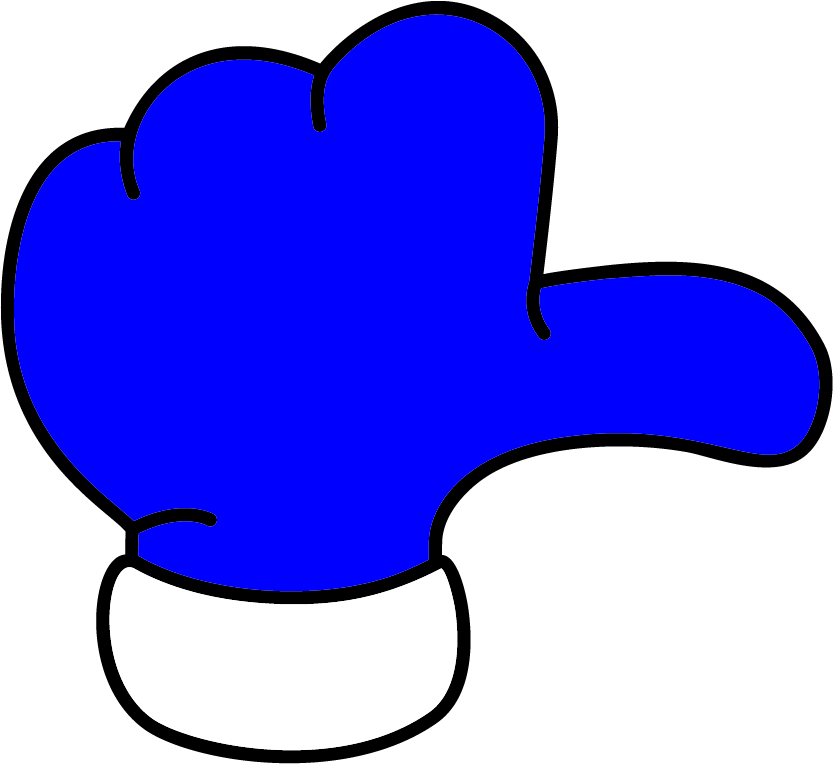
Sums can be in two directions: Right-Handed and Left-Handed. Right-Handed sum, where the summands are to the right of the sum cord (think of your right-handed thumb summing the values of the right hand fingers) and the obverse - Left-Handed Sums, where the summands (the left fingers) are to the left of the left thumb.
Look at the back of your hands, with the thumbs sticking out:
A Right-Handed Sum has 10 = 1+2+3+4 with the sum on the right-thumb, and the fingers representing 1,2,3,4. Right-handed sums are conventionally colored as Red (using the mnemonic R for Red/Right-Handed)
A Left-Handed Sum has 1+2+3+4 = 10 with the sum on the left-thumb, and the fingers representing 1,2,3,4. Left-handed sums are conventionally colored as Blue.
\(\sum_{i,j=A}^{B} G_i P_j = LeftHandedSum\)
As you will come to see, sum directions are important - like links in a spreadsheet, they provide a network graph of summations. That network graph can be analyzed to understand the structure of the khipu. Here for example is the pendant-pendant sum network graph for KH0696. Notice all the arrows, both red and blue, that link into g4p1.
Click on image for a larger view
1.4 Sum Signs
Medrano and Khosla observed that the sum cord was most commonly White. In addition, since it often was of a higher value than the often neighboring summand cords, it could be more easily visually identified as a sum. However, markers for summand ranges (which were not visually as obvious) remained undiscovered until the authors’ discovery of Figure-8-Knots as summand range markers.
In that article, the authors noted that white cords frequently marked where the sums occur. Left hanging, in the Notes section, was note 6:
Many of the sets of summand cords in KH0696 also either begin or end with the value one, designated by a so-called figure eight knot.
In this study we expand on Khosla’s early observation - we conclude that while white cords mark where sums occur, figure-8-knots mark where summand ranges occur. In effect, figure-8-knots act in a manner similar to the modern day parenthesis - an optional, grammatical punctuation marker, indicating the start or end of a range of actions.
2. Methodology
2.1 Database
This study is based on 711 khipus contained in the Khipu Field Guide.
The database is highly heterogenous, and consists of everything from “sheep herder” khipus to the 8 meter long suspected Bolivian khipu KH0082. However, the database also contains anomalous khipus such as Canuto khipus or khipus consisting of solely one cord. Many of the khipus show broken cords, unmeasured values such as spin or cord attachment, etc. Consequently, we should expect large standard deviations in any statistic we measure. An overview of the database quality is available at the “Completeness/Anomalous” table at the Building the KFG Database page
2.2 Drawings
Drawings can be generated from the digital khipu descriptions. In particular three types of drawings have guided this inquiry - as examples for khipu KH0696:
Four sequential inquiries below best illuminate the use of figure-8 knots in the KFG khipus:
Locations - Examining where figure-8-knots occur in the KFG. We learn that the two most common types of occurrences of figure-8-knots are Sole-8-Knots, where a cord has only one knot - a figure-8-knot, and Trailing-8-Knots, where the figure-8-knot is the last knot on the cord (for example a 1 as the last digit of a value).
Fieldmarks - Next we see how figure-8-knots relate to fieldmarks - the computational constructs used in the Khipu Field Guide to identify patterns in the khipu corpus.
Ascher Sums - Having narrowed the search for significance and signal for figure-8-knots, we show how figure-8-knots relate to Ascher Sums.
Summand Marker Statistical Review - A final statistical review confirms the idea that Ascher Sums often have their summand ranges marked by figure-8-knots on at least one side.
Code
```{python}K_VERBOSE_MODE = Falseimport osimport numpy as npfrom scipy import statsimport pandas as pdfrom pandas import Series, DataFramefrom collections import Counterimport qollqa_chuspa as qc # A Khipu Maker is known (in Quechua) as a Khipu Kamayuqimport utils_loom as uloomimport utils_khipu as ukhipuimport utils_pandas as upandaimport utils_kfg_locations as uloc# Plotlyimport plotlyfrom plotly.offline import iplot, init_notebook_modeimport plotly.graph_objects as goimport plotly.express as pximport plotly.figure_factory as ffplotly.offline.init_notebook_mode(connected = False)# Load all khipus(khipu_dict, all_khipus) = qc.fetch_khipus()KFG_Names = ukhipu.kfg_order(khipu_dict.keys()) if (K_VERBOSE_MODE): print(f"Loaded {len(all_khipus)} khipus")```
3. Inquiry #1 - Common Figure-8-Knot Types and Locations
How often does “1” occur, and how often does it occur as the last digit (part of a number >10) versus a sole digit read as 1?
What are common knot-sequences in KFG database, and how do they relate to figure-8-knots?
Where do figure-8-knots occur in the KFG database?
3.1 How often does 1 occur as the last digit? vs a sole digit?
A quick look at the distribution of 1’s as the last digit (later to be called a trailing digit) versus a sole digit on pendant cords vs subsidiary cords, clearly shows that 1’s are more common as a sole digit, than as a last digit. This is a good sign that figure-8-knots do not just serve as a knot in conventional Lockean typology; they have other uses.
Cord Type
Last Digit 1’s (Trailing 1’s)
Sole 1’s
Pendant Cords
33%(1641 of 4996)
67%(3355 of 4996)
Subsidiary Cords
12%(412 of 3424)
88%(3012 of 3424)
This quick look at the distribution of 1’s, broadly answers the “1’s” question. Now let’s examine the distribution of figure-8-knots in the KFG database based on where they occur on a cord.
3.2 Common Knot Type Sequences
A knot type sequence is a list of knot types in a cord starting from the attachment. Just as we might read a cord knot value sequence from top to bottom, we can read a knot type sequence from top to bottom. A frequency analysis of the knot type sequences reveals that Sole-8-Knots occupy an unreasonably high number of cords:
Summary of Knot Sequences and Figure-8 Knot Sequences
Index
Knot Type Sequence
# Cords
# Pendant Cords
# Subsidiary Cords
-
Overall Cords
62837 Cords
72% (45200 of 62837)
28% (17637 of 62837)
0
No Knots
30% (19058 of 62837)
74% (14195 of 19058)
26% (4863 of 19058)
1
L
21% (13000 of 62837)
64% (8317 of 13000)
36% (4683 of 13000)
2
S,L
14% (8509 of 62837)
80% (6801 of 8509)
20% (1708 of 8509)
3
E
10% (6212 of 62837)
52% (3253 of 6212)
48% (2959 of 6212)
4
S
9% (5963 of 62837)
72% (4293 of 5963)
28% (1670 of 5963)
5
S,S,L
4% (2617 of 62837)
89% (2332 of 2617)
11% (285 of 2617)
6
S,E
2% (1325 of 62837)
78% (1033 of 1325)
22% (292 of 1325)
7
S,S
2% (1127 of 62837)
84% (948 of 1127)
16% (179 of 1127)
8
L,L
1% (668 of 62837)
84% (558 of 668)
16% (110 of 668)
9
S,S,S,L
1% (586 of 62837)
94% (548 of 586)
6% (38 of 586)
10
L,L,L
1% (412 of 62837)
92% (380 of 412)
8% (32 of 412)
11
S,S,E
1% (338 of 62837)
89% (301 of 338)
11% (37 of 338)
12
L,E
0% (313 of 62837)
67% (211 of 313)
33% (102 of 313)
13
S,S,S
0% (250 of 62837)
82% (206 of 250)
18% (44 of 250)
14
S,L,E
0% (207 of 62837)
0% (0 of 207)
100% (207 of 207)
Sole Eight Knot Cords occur 10% of the time of all cords in the KFG database
Sole Eight Knots reside equally (52%/48%) on pendants vs subsidiaries. This is unlike any of the other knot sequences which are typically 3 to 1 or 4 to 1 ratios for pendants vs subsidiaries
Roughly 3% (or a little less) of all cords are a Lockean sequence followed by an Eight knot known as a Trailing Figure-Eight-Knot (i.e. S,E, or S,S,E, or L,E)
3.3 Summary of Eight-Knot Types
Figure-8-Knot Type
# Cords of that Type
% Of Pendant Cords
% of Subsidiary Cords
All Figure 8 Knot Cords
15% (8816 of 59144) (# 8-knot cords vs # All khipu cords)
60% (5273 of 8816)
40% (3543 of 8816)
Sole Figure 8 Knot Cords
68% (6036 of 8816)
52% (3127 of 6036)
48% (2909 of 6036)
Trailing Figure 8 Knot Cords
26% (2320 of 8816)
79% (1830 of 2320)
21% (490 of 2320)
Leading Figure 8 Knot Cords
2% (148 of 8816)
72% (106 of 148)
28% (42 of 148)
Mixed Figure 8 Knot Cords
1% (109 of 8816)
71% (77 of 109)
29% (32 of 109)
Multiple Figure 8 Knot Cords
1% (128 of 8816)
64% (82 of 128)
36% (46 of 128)
Middle Figure 8 Knot Cords
1% (75 of 8816)
68% (51 of 75)
32% (24 of 75)
From now on, we will focus on cases of either a cord with a trailing Figure-Eight-Knot, or a cord with a sole Figure-Eight-Knot. If it’s a mixed Figure-Eight-Knot, or multiple-only Figure-Eight-Knots it will be considered to be a leading and trailing Figure-Eight-Knot.
Accordingly, the new measures are:
Figure-8-Knot Type
% of Khipus
# Cords of that Type
% Of Pendant Cords
% of Subsidiary Cords
All Figure 8 Knot Cords
78% (516 of 664)
15% (8816 of 59144) (# 8-knot cords vs # All khipu cords)
60% (5273 of 8816)
40% (3543 of 8816)
Sole Figure 8 Knot Cords
56% (373 of 664)
68% (6036 of 8816)(# Sole 8-knot cords of # All 8-Knot cords)
52% (3127 of 6036)
48% (2909 of 6036)
Trailing Figure 8 Knot Cords
61% (404 of 664)
29% (2542 of 8816)
78% (1984 of 2542)
22% (558 of 2542)
Leading Figure 8 Knot Cords
9% (57 of 664)
2% (163 of 8816)
68% (111 of 163)
32% (52 of 163)
3.4: Summary of All Figure-8-Knot Khipus
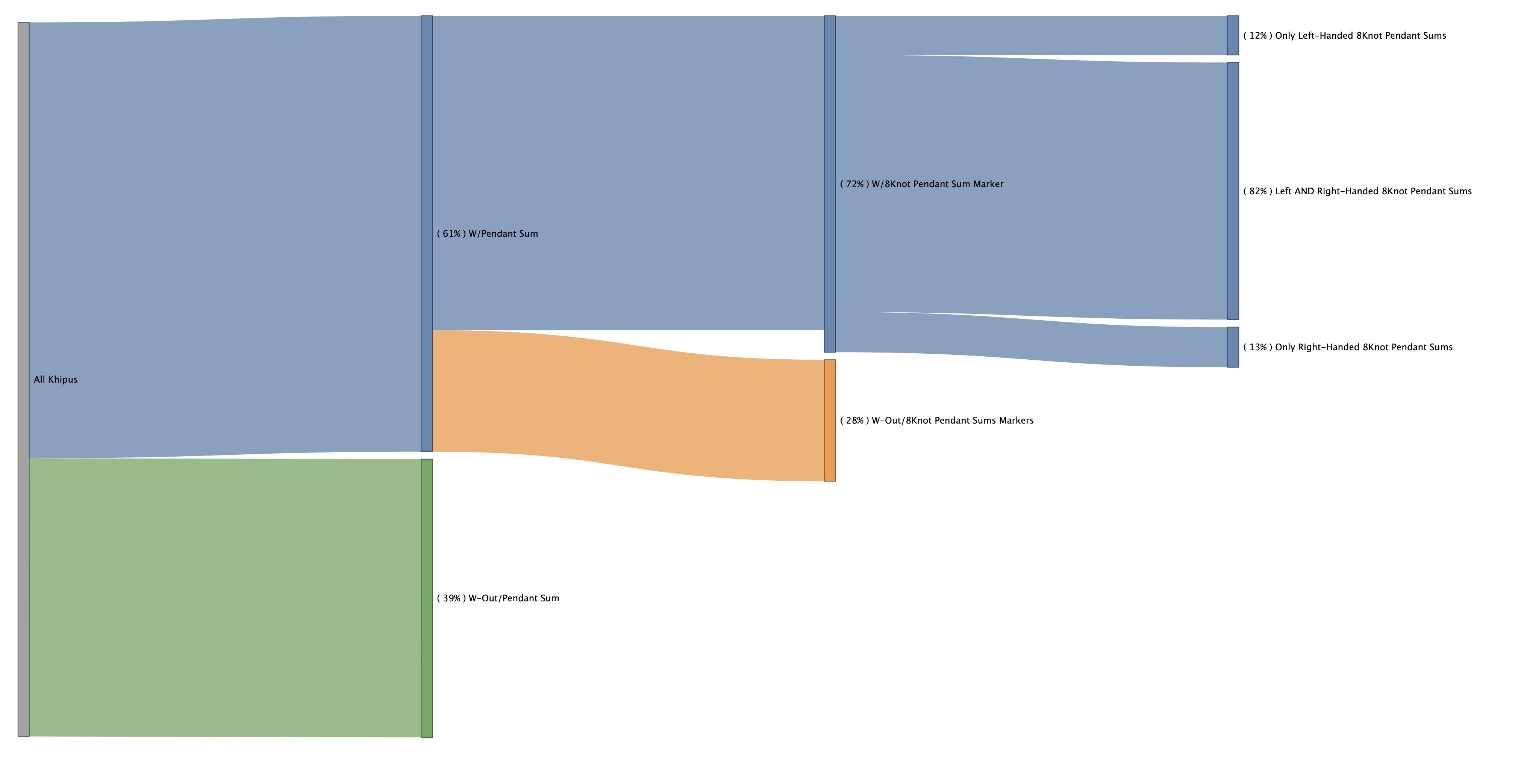
The apportionment of knot types, pendant/subsidiaries, etc., is summarized in the Sankey Diagram below:
Significant points:
78% of the khipus in the KFG have Figure-8-Knot cords
Only 15% of the cords in the KFG have Figure-8-Knot cords
There is roughly a 2:1 ratio of Sole-8 Knot cords (i.e. a knot-sequence of ‘E’) to Trailing Figure-8-Knot cords (i.e. ‘S,E’, ‘S,L,E’, etc)
Sole-8-Knot cords occur roughly equally 1:1 on primaries and subsidiaries, but Trailing Figure-8-Knot cords have the more common 2:1 or 3:1 pendant to subsidiary frequency count.
Khipus w/Figure-8-Knots
3.5 Summary of 8 Knot Locations
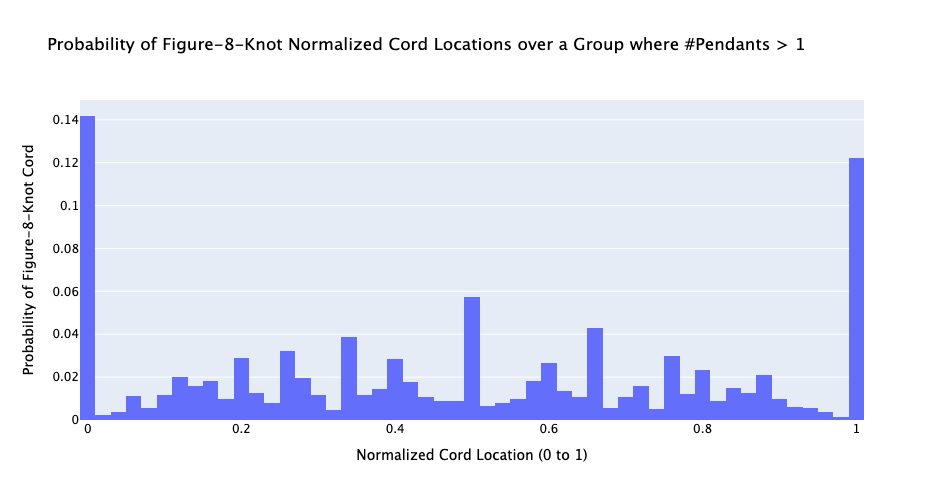
Figure-8-Knot cords have a high probability of occuring in the first group of a khipu.
The middle group has a medium probability it will contain a figure 8 knot cord.
Figure-8-Knot cord frequencies also spike at 1/4 and 3/4 of the way through the groups in the khipus.
Similarly by analogy:
The first cord of a group has a high probability of containing a figure-8-Knot cords
The last cord of a group has ~3/4 of the probability of the first cord containing a figure-8-knot cord
The middle cord has a medium probability it will contain a figure 8 knot cord.
Figure-8-Knot cord frequencies also spike at 1/3 and 2/3 of the way through a group.
The following images layout the evidence for these claims:
Code
```{python}# Read in the Fieldmark and its associated dataframe and match dictionaryfrom fieldmark_figure8knots import FieldmarkFigure8Knotsfigure8knot_fieldmark = FieldmarkFigure8Knots()figure8_knot_fieldmark_df = figure8knot_fieldmark.fieldmark_df().sort_values('num_8knot_cords', ascending=False)figure8_knot_fieldmark_df.sort_values('num_8knot_cords', ascending=False, inplace=True) raw_match_dict = figure8knot_fieldmark.raw_match_dict()# Plot Matching khipumatching_khipus = figure8knot_fieldmark.matching_khipus()[:100]matching_values = [raw_match_dict[aKFG_Name] for aKFG_Name in matching_khipus]matching_df = pd.DataFrame(list(zip(matching_khipus[::-1], matching_values[::-1])), columns =['KFG_Name', 'Value'])fig = (px.bar(matching_df, x='Value', y='KFG_Name', labels={"KFG_Name": "Khipu Name", "Value": "# of Cords (Including Subsidiaries) with Figure-8-Knots", }, title=f"Top 100 Matching Khipus - # of Cords (Including Subsidiaries) w Figure-8-Knots", width=944, height=1500) .update_layout(showlegend=True, yaxis = dict(tickfont = dict(size=8)), xaxis= dict(tickangle=270), font_family="Lucida Grande", font_color="black", title_font_family="Lucida Grande", title_font_color="black", legend_title_font_color="black") .show())```
4. Inquiry #2 - What Fieldmarks Associate with Figure 8 Knots
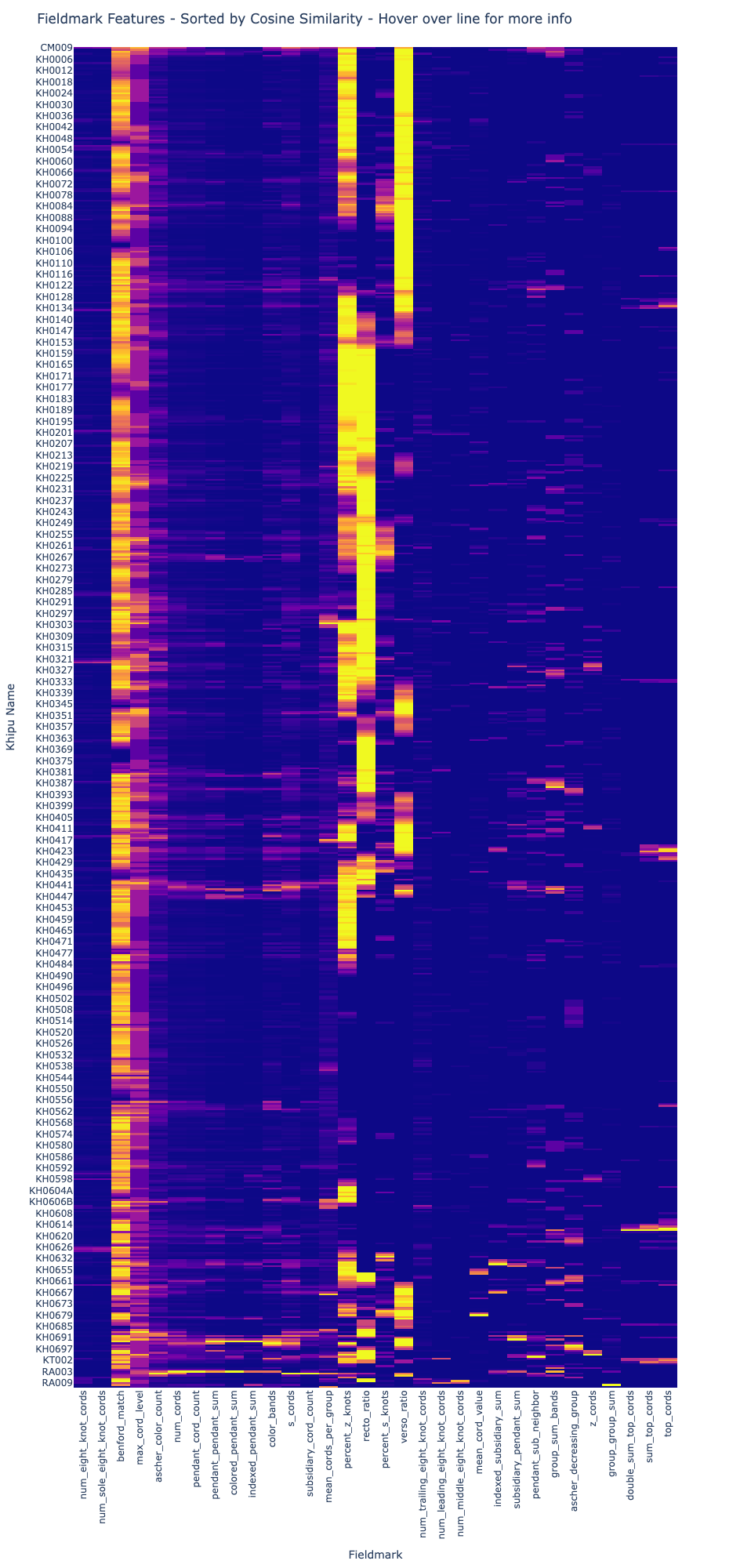
The column sorting reveals the association of figure-eight-knot cords with other khipu fieldmarks.
Set 1:
Num Eight Knot Cords
Num Sole Eight Knot Cords
Set 2:
Benford Match
Max Cord Level
Ascher Color Count
Num Cords
Pendant Cord Count
Set 3:
Pendant Pendant Sum
Colored Pendant Sum
Indexed Pendant Sum
Group Group Sum
Set 4:
Color Bands
S Cords
Subsidiary Cord Count
Mean Cords per Group
Percent Z Knots
Recto Ratio
Percent S Knots
Verso Ratio
Set 5:
Num Trailing Eight Knot Cords
Num Leading Eight Knot Cords
Num Middle Eight Knot Cords
Set 6:
Top Cords
Sum Top Cords
Double Sum top Cords
Ascher Decreasing Group
Subsidiary Pendant Sum
Indexed Subsidiary Sum
Pendant Sub Neighbor
Z Cords
Mean Cord Value
Observations:
Set’s 1 and 5 are the Figure-8-Knot sets.
Set 1 is interesting due to the 2nd Fieldmark - Sole-8-Knots. Sole-8-Knots were present in 68% of all cords with a Figure-8-Knot, and are distributed 52%/48% over pendants/subsidiaries.
Set 2 is the Benford Match set, indicating that Sole-8-Knots match with highly numeric khipus. Benford Match khipus are strongly associated with numeric khipus (as opposed to narrative khipus), and this tells us that Figure-8-Knots are associated with numeric, not narrative khipus.
Set 3 are Ascher sums. Here is the first evidence that Sole-8-Knots have a causal relationship with Ascher sums - especially Pendant, Colored, and Indexed Pendant Sums.
Set 5 comprises the 32% of the Figure-8-Knot Cords that are mostly Lockean sequences followed by a Figure-8-Knot (with the rare exception of Leading and other Eight-Knot types). What are these Figure-8-Knot types telling us? The fact that Banded khipus (color_bands) are associated with sums makes intuitive sense - Banded khipus are more likely to have sums, therefore more likely to have figure-8-knots.
5. Inquiry #3 - Where do Figure-8-Knots Mark Ascher Sums?
It was discovered that Figure-8-Knots mark Ascher Summands on or close to the left or right (or both) edges of a summand range. The knots can be on the pendant, or on the subsidiary. A brief summary of the results is included here:
5.1.1 Summary of Left-Handed Eight Knot Ascher Sum Types
8-KNOT CORD TYPE
# 8Knot Cord Sum Markers
# Edge Matches
# Pendant Edge Matches
# Subsidiary Edge Matches
# Neighbor Matches
# Neighbor Pendant Matches
# Neighbor Subsidiary Matches
0
SOLE 8KNOT CORDS
59% (2346 of 3969)
56% (1312 of 2346)
66% (867 of 1312)
34% (445 of 1312)
44% (1034 of 2346)
59% (611 of 1034)
41% (423 of 1034)
1
TRAILING 8KNOT CORDS
41% (1623 of 3969)
56% (909 of 1623)
88% (796 of 909)
12% (113 of 909)
44% (714 of 1623)
84% (599 of 714)
16% (115 of 714)
5.1.2 Right-Handed Eight Knot Ascher Sums Summary
8-KNOT CORD TYPE
# 8Knot Cord Sum Markers
# Edge Matches
# Pendant Edge Matches
# Subsidiary Edge Matches
# Neighbor Matches
# Neighbor Pendant Matches
# Neighbor Subsidiary Matches
0
SOLE 8KNOT CORDS
58% (2997 of 5156)
54% (1613 of 2997)
58% (928 of 1613)
42% (685 of 1613)
46% (1384 of 2997)
51% (709 of 1384)
49% (675 of 1384)
1
TRAILING 8KNOT CORDS
42% (2159 of 5156)
51% (1107 of 2159)
86% (951 of 1107)
14% (156 of 1107)
49% (1052 of 2159)
83% (873 of 1052)
17% (179 of 1052)
What about the inverse. What sums are marked by Figure-8-Knots?
5.2 Sankey Diagram of Sums Organized by Figure-8-Knot Marker Type
5.2.1 Khipu Sums by Percentage of Figure-8-Knot Marker Type
Click on image to view larger
5.2.2 Pendant Ascher Sums by Percentage of Figure-8-Knot MarkerType
Click on image to view larger
6. - Diagrammatic Representations of the Ascher Summand Ranges by Figure-8 Knots
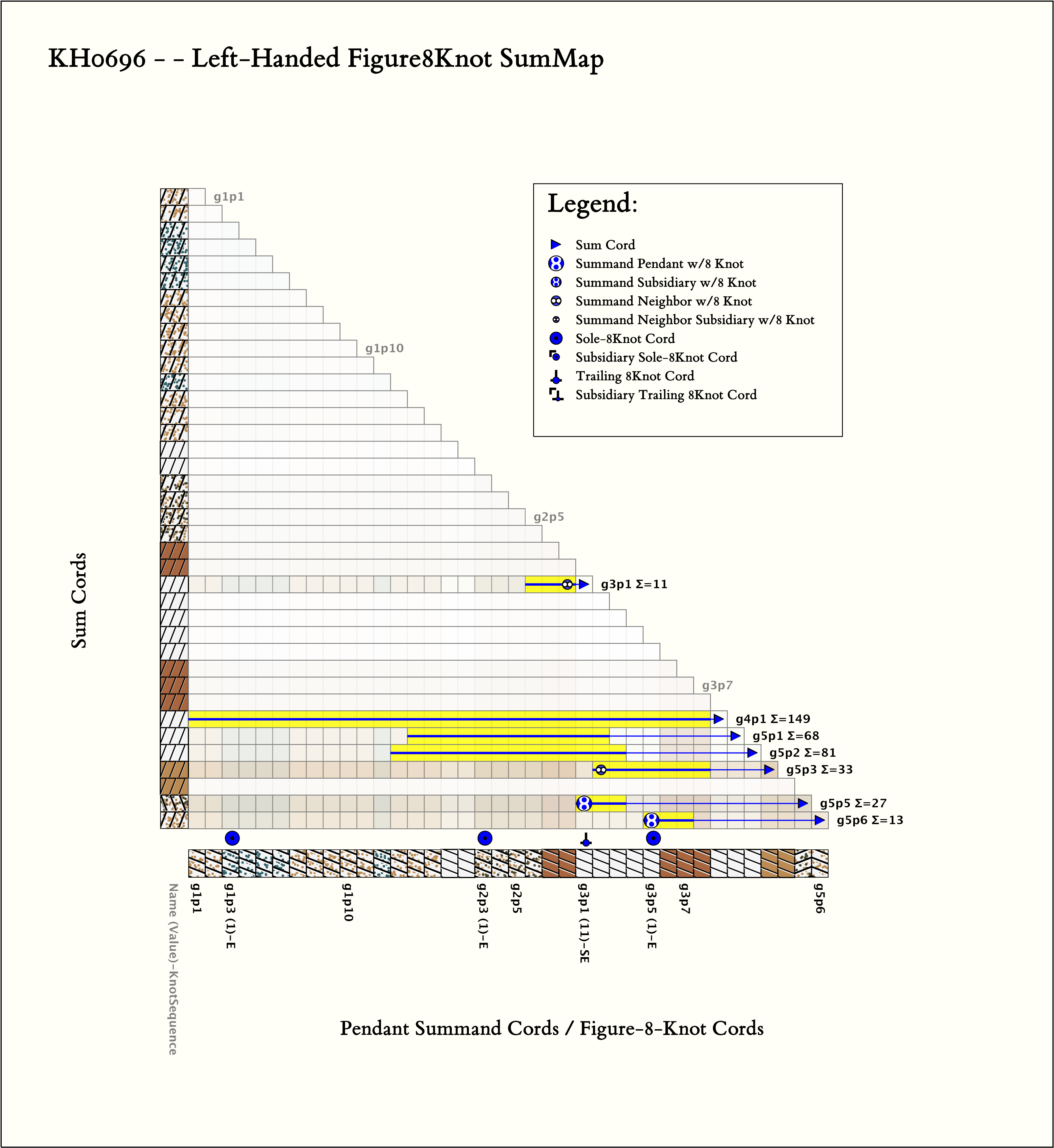
We can build a summand map of Ascher Sums marked by Figure8Knots for Left and Right-Handed Sums. For example here is the summand map for Left-Handed Sums for KH0696:
A full image quilt of sums for each of the Pendant Ascher Sums is available:
An independant statistical review has been performed by author Agustín Da Fieno Delucchi. Notable highlights from his review:
7.1 Figure-8-Knot Base Rates
Across 711 khipus (45,200 pendant cord positions), 12.5% of all pendant cords carry an Figure-8-Knot — roughly one in eight. This is \(p_e\), the null probability for any single cord being an Figure-8-Knot under random placement.
Of all Figure-8-Knot cords: - Sole Figure-8-Knots (58.1%) carry only the figure-eight knot — no single or long knots. Their numeric content is ambiguous; they are most naturally read as non-numeric markers. - Trailing Figure-8-Knots (38.5%) append the figure-eight to a numeric sequence (SE = 11, LE = 10+E, etc.). They encode a genuine numeric value and an Figure-8-Knot. - Other (3.4%) includes leading or embedded Figure-8-Knots.
The histogram shows the distribution is right-skewed: most khipus have only a few Figure-8-Knot cords, but a long tail extends to over 150 per khipu. Khipus with many Figure-8-Knots may be employing them systematically as structural markers throughout the record.
This base rate is the benchmark for all enrichment tests that follow. Any boundary Figure-8-Knot rate significantly above 12.5% is a signal that Figure-8-Knots are targeted toward summand boundary positions rather than distributed at random.
7.2 Boundary Enrichment — Are Figure-8-Knots Over-Represented at Summand Edges?
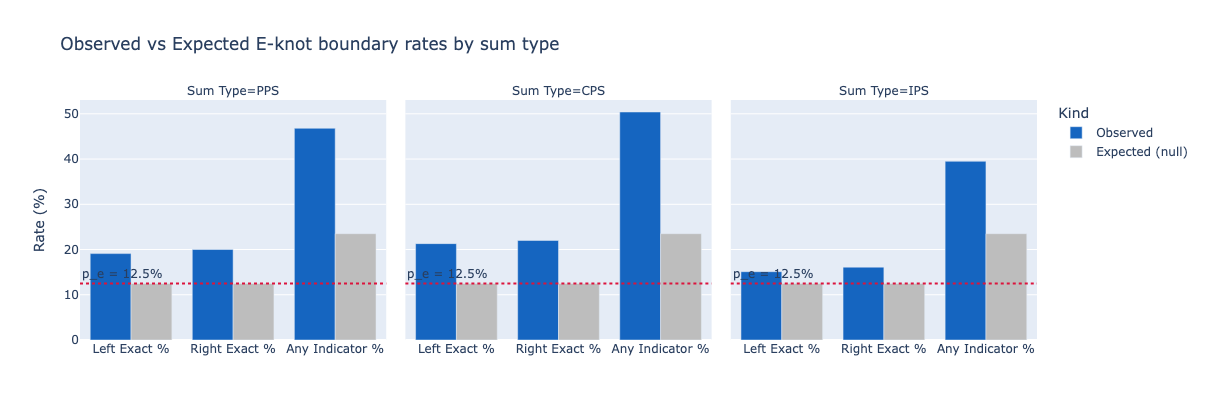
Across all three sum types, every boundary measure exceeds the base rate:
Left and right exact rates (~15–21%) are consistently above \(p_e\) = 12.5%
Close-neighbor rates (~14–18%) are above the base rate but below exact rates
The “any indicator” rate (~40–50%) is roughly 2× the expected value (23%)
The fact that exact-boundary placement exceeds close-neighbor placement tells us the marking convention is positionally precise — Figure-8-Knots land on the actual boundary cord, not just somewhere near the boundary.
The close-neighbor rate exceeding the base rate is also meaningful: it accounts for scribal variation in marker placement (is the marker “on the last summand” or “just after the last summand”?) and shows the enrichment extends symmetrically around the edge.
7.3. Formal Statistical Tests — Binomial Tests for Each Sum Type
Under the null hypothesis \(H_0\): Figure-8-Knot cords are distributed independently and uniformly across all pendant cords at rate \(p_e\).
For a given sum type with \(n\) sums, the expected number of left-boundary Figure-8-Knots under \(H_0\) is \(n \cdot p_e\) (binomial). The test asks:
\[P(X \geq k_\text{observed} \mid X \sim \mathrm{Binomial}(n,\, p_e))\]
If this p-value is very small, \(H_0\) is rejected — Figure-8-Knots appear at boundaries more than chance.### Statistical Results
The binomial p-values are astronomically small for every sum type and every boundary measure:
Left exact (first summand cord has Figure-8-Knot): p ≈ 8 × 10⁻⁹² across all sums
Right exact (last summand cord has Figure-8-Knot): comparable significance
Any indicator (either boundary has a marker): p → 0 (below float precision)
This decisively rejects the null hypothesis. Figure-8-Knot cords appear at summand boundaries far more often than chance at the corpus base rate.
Odds ratios ~1.5–2× are moderate in magnitude but the precision of the estimate is enormous (~12,000 sums). A 1.5× enrichment over a 12.5% base rate is not subtle — it represents hundreds of extra Figure-8-Knot boundary placements above chance across a corpus of ~700 khipus.
7.4 Left–Right Symmetry
If Figure-8-Knots mark a range (not just a starting point), the left and right boundary enrichment rates should be approximately equal. An asymmetric marker (e.g., only at the start of a range) would suggest a different convention — more like a label than a delimiter.
We test symmetry in two ways: 1. Rate comparison: are left-exact and right-exact rates the same across sum types? 2. Exact vs. close: does the exact-edge placement consistently dominate?
Symmetry is also tested for close-neighbor placements.
Left ≈ Right: The left-exact and right-exact rates are within a few percentage points of each other across all three sum types. This bilateral symmetry is the expected signature of a range delimiter: both ends of the range are marked with equal frequency. A unidirectional label (e.g., “this cord is a sum cord”) would show asymmetry.
Exact > Close: The exact-edge rate (Figure-8-Knot on the boundary cord) is consistently higher than the close-neighbor rate (Figure-8-Knot on the cord adjacent to the boundary). The exact/close ratio is roughly 1.1–1.2×. This means scribes preferentially placed the marker on the boundary cord itself — a positionally precise convention.
Both rates above the base rate: Even the close-neighbor rate (~14–18%) exceeds the corpus base rate (12.5%), confirming that the enrichment extends slightly beyond the exact edge. This is consistent with scribal variation in placement (some scribes placed the marker one position outside the range, others on the boundary cord itself).
7.5. Figure-8-Knot Type Composition at Summand Boundaries
We have shown that Figure-8-Knots are enriched at summand boundaries. A natural follow-up question is: which type of Figure-8-Knot appears at those boundary positions?
A sole Figure-8-Knot cord carries nothing but the figure-eight knot — no S knots, no L knots. Its “numeric value” is ambiguous. A trailing Figure-8-Knot cord (sequence SE, LE, SSE, …) has genuine numeric content and an Figure-8-Knot appended (e.g., SE = 11, LE = 10+E).
If Figure-8-Knots at boundaries serve the same scribal purpose as Figure-8-Knots elsewhere in the corpus, the sole/trailing composition should look the same at boundaries as in non-arithmetic contexts. If the composition shifts, that shift tells us something about how boundary marking works in practice.
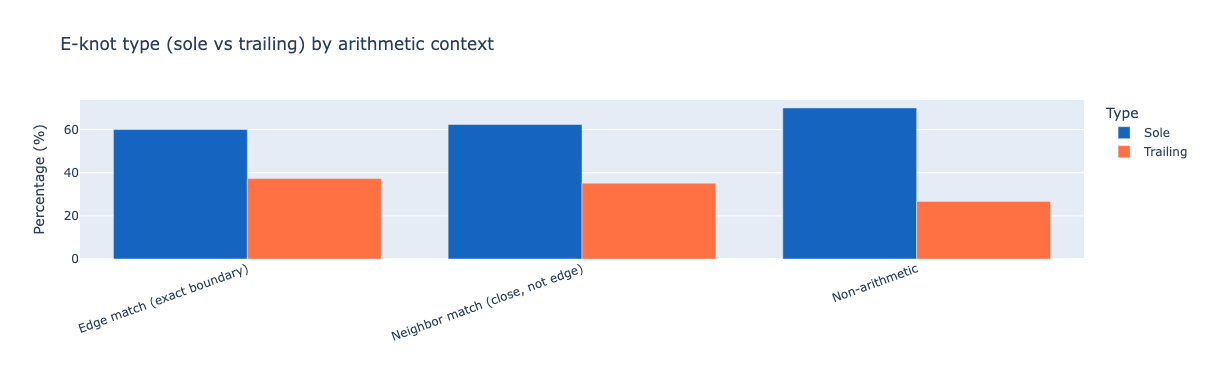
We partition all Figure-8-Knot cord entries into three groups and compare their knot-type distributions: - (a) Edge match — Figure-8-Knot cord lies exactly on a detected summand boundary - (b) Neighbor match — Figure-8-Knot cord is adjacent to a boundary but not on it - (c) Non-arithmetic — no sum relationship detected for this Figure-8-Knot cord
Interpretation - Figure-8-Knot Composition Shifts at Boundaries
The chi-squared test (χ² = 130.9, df = 1, p = 2.6 × 10⁻³⁰) confirms that the sole/trailing distribution is significantly different between edge-matched and non-arithmetic Figure-8-Knot cords.
The direction of the shift is informative — look at the three groups from left to right in the chart:
Context
Sole %
Trailing %
Interpretation
Non-arithmetic
~66%
~26%
Most “pure” profile — sole dominates outside arithmetic contexts
Neighbor match
~62%
~33%
Intermediate
Edge match
~60%
~37%
Trailing Figure-8-Knots proportionally more common at exact boundaries
Trailing Figure-8-Knots (cords with numeric value + figure-eight) are proportionally more enriched at summand boundaries than they are in non-arithmetic contexts. Sole Figure-8-Knots are still the majority type at edges (~60%) — matching roughly their corpus-wide proportion — but the enrichment specifically pulls trailing Figure-8-Knots disproportionately toward boundary positions.
A plausible mechanism: scribes sometimes encoded a small numeric value on the boundary cord itself (e.g., the value 11 as SE) while simultaneously using the appended Figure-8-Knot as a range delimiter. This creates a trailing Figure-8-Knot that is both arithmetically meaningful and structurally marked. Sole Figure-8-Knots at boundaries are more numerous overall, but their relative prevalence does not increase at boundary positions — sole Figure-8-Knots are the dominant type throughout the corpus, not specifically at boundaries.
The key conclusion remains: Figure-8-Knot type composition at summand edges is statistically distinct from non-arithmetic Figure-8-Knot usage (p = 2.6 × 10⁻³⁰), confirming that boundary-positioned Figure-8-Knots occupy a different functional context. Both sole and trailing types participate in the boundary-marking convention.
7.6 Statistical Review Conclusions
Five independent lines of evidence all point to the same conclusion:
Evidence Summary
#
Test
Result
Interpretation
1
Binomial enrichment (left boundary)
p ≈ 8 × 10⁻⁹²
Far more Figure-8-Knots at left edges than expected by chance
2
Binomial enrichment (any boundary)
p → 0
~46% of sums have a marker vs 23% expected under independence
3
Left–Right symmetry
Left ≈ Right
Figure-8-Knots mark a range (both ends), not a label on one cord
4
Exact > Close placement
Exact/close ratio ≈ 1.15×
Markers land precisely on the boundary, not just “nearby”
5
Figure-8-Knot type composition shift
χ² = 130.9, p = 2.6 × 10⁻³⁰
Boundary Figure-8-Knots are proportionally richer in trailing type; distribution is distinct from non-arithmetic contexts
6
Corpus-wide prevalence
333 of 432 khipus-with-sums (77%) have ≥1 marked boundary
The convention is widespread, not an outlier effect
The Mechanism
The data support the following scribal convention:
When a khipu scribe knotted a summand range, they optionally placed a figure-eight knot at the first and/or last cord of the range to delimit its extent. The marker could be a sole Figure-8-Knot (a cord with nothing but the figure-eight knot) or a trailing Figure-8-Knot on a cord that also carries numeric content, placed exactly on the boundary cord. Some scribes placed the marker one cord outside the range instead.
Both sole and trailing Figure-8-Knot types participate in boundary marking. Non-arithmetic Figure-8-Knots are disproportionately sole (~66%), consistent with a separate toponym or decimal-position role. At summand boundaries, Figure-8-Knots appear in approximately their corpus-wide proportions, with a slight elevation in trailing type — suggesting that value-bearing cords (e.g., the value 11 = SE) can simultaneously serve as structural markers.
This is not the only use of Figure-8-Knots in the corpus: - ~12.5% of all pendant cords have an Figure-8-Knot regardless of sum structure - Many Figure-8-Knots encode the numeric value 1 (in the Lockean system) - Some Figure-8-Knots appear in non-arithmetic roles (possibly toponym markers, cf. Urton & Brezine 2005)
What the KFG sum fieldmarks establish is that a systematic subset of Figure-8-Knot usage is arithmetically structured — and that subset is statistically unmistakable.
Quantitative Summary
Corpus:  711 khipus,  45,200 pendant cord positions
Base rate p_e = 12.47%  (one in eight pendant cords has an Figure-8-Knot)

Across 12,304 detected sums (PPS + CPS + IPS combined):
  Left exact:    2,358 / 12,304  ~= 19%   (1.52× base rate)
  Right exact:   2,459 / 12,304  ~= 20%   (1.61× base rate)
  Any indicator: 5,751 / 12,304  ~= 47%   (1.98× expected 23.4%)

Per-sum-type exact boundary rates range from ~15% (IPS) to ~22% (CPS) —
all significantly above the 12.5% base rate.

Among 432 khipus with at least one detected sum:
  333 (77%) have at least one Figure-8-Knot boundary marker
  222 (51%) have markers on 50%+ of their sums

Binomial p-values: < 10^-80 for every measure and every sum type.
Monte Carlo (50,000 sims): observed count never reached in simulation.
Chi² (sole vs trailing: edge vs non-arithmetic): 130.9, p = 2.6e-30
Figure-8-Knots are summand range markers.
8. Conclusions
8.1 Figure-8-Knots as Toponyms:
As seen in a previous analyses of toponyms, it appears unlikely that Figure-8-Knots are toponym markers.
8.2 Figure-8-Knots in General:
Figure-8-Knot Type
% of Khipus
# Cords of that Type
% Of Pendant Cords
% of Subsidiary Cords
All Figure 8 Knot Cords
78% (516 of 664)
15% (8816 of 59144) (# 8-knot cords vs # All khipu cords)
60% (5273 of 8816)
40% (3543 of 8816)
Sole Figure 8 Knot Cords
56% (373 of 664)
68% (6036 of 8816) (# Sole 8-knot cords of # All 8-Knot cords) 10% (6036 of 59144)(# Sole 8-knot cords vs # All khipu cords)
52% (3127 of 6036)
48% (2909 of 6036)
Trailing Figure 8 Knot Cords
61% (404 of 664)
29% (2542 of 8816)
78% (1984 of 2542)
22% (558 of 2542)
Leading Figure 8 Knot Cords
9% (57 of 664)
2% (163 of 8816)
68% (111 of 163)
32% (52 of 163)
Significant points:
78% of the khipus in the KFG have Figure-8-Knot cords
15% of the cords in the KFG have Figure-8-Knot cords
10% of all cords in the KFG database have Sole Eight Knot Cords. An astoundingly high percentage. There is roughly a 2:1 ratio of Sole-8 Knot cords (i.e. a knot-sequence of ‘E’) to Trailing Figure-8-Knot cords (i.e. ‘S,E’, ‘S,L,E’, etc).
Sole-8-Knot cords occur roughly equally 1:1 on primaries and subsidiaries, but Trailing Figure-8-Knot cords have the more common 2:1 or 3:1 pendant to subsidiary frequency count.
Figure-8-Knots have a high probability of being found on the first or last cord of a group.
8.3 Figure-8-Knots and Pendant Ascher Sums
8.3.1 Khipu Sums by Percentage of Figure-8-Knot Marker Type
Click on image to view larger
8.3.2 Pendant Ascher Sums by Percentage of Figure-8-Knot MarkerType
Eight types of Figure-8-Knots Summand Markers are found in the KFG:
Sole-8-Knot versus Trailing 8-Knot
On the bounday versus adjacent to the boundary
On the pendant cord versus subsidiary cord.
Click on image to view larger
8.3.3 Other Observations
Figure-8-Knots closely associate with basic Ascher sums and banded khipus as shown above in section 4.7
Indicate where crucial sums start/end. 72% of Pendant Ascher Sums are marked by a Figure-8-Knot summand marker - an unexpectedly high frequency.
Figure-8-Knot indicators match equally for both right-handed and left-handed sums
Have interesting associations with group sum bands and group sum matches. Perhaps a family of khipu species is emerging here, based on this fieldmark, banded khipus, cluster sum bands/matches….
9. Acknowledgements
In the article “Information Control in the Palace of Puruchuco: An Accounting Hierarchy in a Khipu Archive from Coastal Peru by Gary Urton and Carrie J. Brezine, there is a short section describing “Toponyms” - indicators of a particular place. Brezine and Urton divide the Puruchuco khipus into three levels of hierarchy - Level 1 being “ground level” and Level 2 and 3 being summations of their lower levels.
To quote:
Introductory Segments
We assume that the accounting hierarchy shown in figure 5 was a set of records for use both within and outside Puruchuco. The use of this information at a wider level, perhaps regional or provincial, would have been connected with the reporting function of some or all of these khipus. For example, khipus on level III could represent either a set of instructions issued to the lord of Puruchuco from the provincial governor, or reports on local Puruchuco resources to be sent to the provincial governor. In either of these scenarios, one of the requirements would have been that the khipus bear an indication of their destination or origination. … If numerous khipus were coming into a central archive for storage or were being dispersed from that archive to disparate places, it would have been helpful, if not essential, to have place identifiers encoded within each khipu. We suggest that the introductory segments on level II and III khipus represented just such identity labels (see Pärssinen, 1992:39–43)… The numerical values knotted onto strings within the introductory segments on level II and III khipus all contain arrangements of just three figure-Eight-Knots (denoted E) tied onto three separate strings (see fig. 8). Figure-Eight-Knots normally signify the numerical value one (1), however it is important to note that the numeric values on these introductory segments are neither derived from nor implicated in the summation/ partition relationship.
The introductory segments in all cases occur near the short, doubled end of the primary cord, which is usually taken to be the beginning of a khipu account. We hypothesize that the arrangement of three figure-Eight-Knots at the start of these khipus represented the place identifier, or toponym, “Puruchuco.” Three figure-Eight-Knots tied onto a few of the dozen or so strings is not a lot of information by which to signal a toponym. It is difficult for us to explain otherwise, however, the purpose of these parallel sets of strings, which do not figure in any discernible way into the summation/partition relations. We suggest that any khipu moving within the state administrative system bearing an initial arrangement of three figure-Eight-Knots would have been immediately recognizable to Inka administrators as an account pertaining to the palace of Puruchuco. This implies that there ought to be place identifiers relating to khipus from other archives as well, though we are not prepared to suggest other such labels at this time.
This page is an outgrowth, by Ashok Khosla, Di Hu and Kylie Quave, of a previous attempt to find toponyms, using figure-8-knots, as described by Urton and Brezine.
The hypothesis that figure-8-knots appear as labels finds credible evidence in the marking of Ascher Sums. However, besides the Puruchuco khipus, we were unable to find figure-8-knots as toponyms in the rest of our khipu corpus.
The authors especially wish to thank Di Hu for her subsequent feedback on the role that figure-8-knots play in Ascher Sums.
10. Bibliography
Ashley, Clifford W. (1944). The Ashley Book of Knots. New York: Doubleday. p. 85. ISBN 0-385-04025-3.
Ascher, M., & Ascher, R. (1978). Code of the Quipu databook. Ann Arbor, MI: University of Michigan Press.
Ascher, M., & Ascher, R. (1988). Code of the Quipu databook II. Ithaca, NY: Ascher and Ascher.
Artzi, Bat-ami. 2010. “The Secret of the Knot: Khipu No. 936 from the Maiman Collection.” Estudios Latinoamericanos 30: 187–214. https://doi.org/10.36447/Estudios2010.v30.art8.
FitzPatrick M. Knot Tricks: What Mathematical Knot Theory Can Reveal about the Structure of Khipu Knot Encoding. Latin American Antiquity. Published online 2026:1-17. doi:10.1017/laq.2026.10171
Hyland, S. (2024). Knot Anomalies on Inka Khipus: Revising Locke’s Knot Typology. Zea Books. https://doi.org/10.32873/unl.dc.zea.1617
Ifrah, G. (2000). The universal history of numbers: From prehistory to the invention of the computer (D. Bellos, E. F. Harding, S. Wood, & I. Monk, Trans.). John Wiley & Sons.
Locke, L. Leland. The Ancient Quipu or Peruvian Knot Record. New York: The American Museum of Natural History, 1923.
Medrano, Manuel, and Ashok Khosla. “How Can Data Science Contribute to Understanding the Khipu Code?.” Latin American Antiquity 36, no. 2 (2025): 497-516. doi:10.1017/laq.2024.5.
Menninger, K. (1969). Number words and number symbols: A cultural history of numbers (P. Broneer, Trans.). MIT Press.
Urton, G., & Brezine, C. J. (2005). Khipu Accounting in Ancient Peru. Science, 309, 1065–1067. https://doi.org/10.1126/science.1113426
Urton, G. (2003). Signs of the Inka khipu: Binary coding in the Andean knotted-string records. University of Texas Press.
Footnotes:
1. Locke was lucky. Top cords comprise only about 4% of the KFG khipus! 2. In this sense, a “region” is a group of cords with similar obvious properties, such as attachment or color. A border is the meeting of two different regions, and a border location is the one or two cords that abut the two regions.






 Interpretation - Figure-8-Knot Composition Shifts at Boundaries